
Articles
Please use the filters and search bar below to find articles that have been published in SWOT Report. All past SWOT Report articles are also available as PDFs in the SWOT Report section of this site.
Filter by Tags
- Africa 18
- Arribada 1
- Asia 23
- Atlantic Ocean 36
- Atlas 10
- Australia 8
- Cabo Verde 1
- Caribbean Sea & Gulf of Mexico 28
- Climate Change 14
- Coastal Development 16
- Direct Take 31
- East Indian and Southeast Asia 1
- East Pacific 1
- Europe 8
- FAQs 14
- Fisheries Bycatch 26
- Flatback 3
- Genetics 1
- Global 90
- Grants 5
- Green turtle 37
- Hawksbill 30
- India 1
- Indian Ocean 23
- Indonesia 1
- Kemp's ridley 11
- Leatherback 30
- Loggerhead 34
- Mediterranean Sea 7
- Mexico 1
- North America 36
- North Atlantic 1
- Olive ridley 11
- Outreach and Action 8
- Pacific Ocean 46
- Plastic 2
- Policy and Economics 5
- Pollution and Pathogens 17
- Rescue and Rehabilitation 4
- Research and Status 8
- SWOT Team Update 1
- South America 26
- South Atlantic 1
- Southeast Asia 2
- Special Feature 21
- Tortoiseshell 2
- Trade 2
- West Indian Ocean 2
- West Pacific 1
Filter by SWOT Report
- Announcements 1
- Online Exclusive Articles 16
- SWOT Report vol. 1 15
- SWOT Report vol. 10 12
- SWOT Report vol. 11 10
- SWOT Report vol. 12 12
- SWOT Report vol. 13 15
- SWOT Report vol. 14 14
- SWOT Report vol. 15 13
- SWOT Report vol. 16 16
- SWOT Report vol. 17 15
- SWOT Report vol. 18 13
- SWOT Report vol. 19 20
- SWOT Report vol. 2 24
- SWOT Report vol. 20 14
- SWOT Report vol. 21 13
- SWOT Report vol. 3 18
- SWOT Report vol. 4 13
- SWOT Report vol. 5 13
- SWOT Report vol. 6 12
- SWOT Report vol. 7 13
- SWOT Report vol. 8 4
- SWOT Report vol. 9 18


The Continuing Tale of Circle Hooks in Brazil
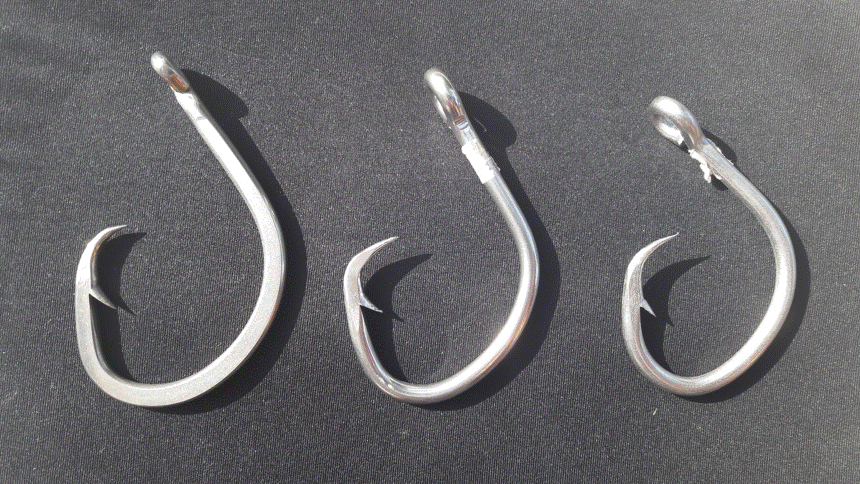
Incidental capture of sea turtles in pelagic and coastal fisheries (also called bycatch) is arguably the greatest threat to sea turtles worldwide. Yet, until recently, there was practically no information regarding sea turtle interactions with longline fisheries in the southwestern Atlantic Ocean. The first studies about this topic were made public by Uruguayan researchers in 1998, the same year that Brazilian researchers presented a report about the incidental capture of loggerhead turtles by longline vessels in Brazil. Although the government insisted that incidental capture was very low, Brazilian NGOs such as Projeto TAMAR asserted the opposite.

Addressing the Plastic Pollution Challenge in Uruguay
In Uruguay, the threat of plastic pollution looms large in an area considered to be an important foraging and developmental habitat for sea turtles in the southwestern Atlantic Ocean. In recent years, NGO Karumbé has focused in on the issue of plastic pollution through strong community engagement programs designed to embed conservation ethics in the Uruguayan people.

Scientific Tourism, Fibropapillomatosis, and Learning to Stay Out of Nature's Way
It is seven o’clock in the morning, and we are on an old wooden pier in a mangrove swamp on the south coast of Bahia, Brazil. After a night spent on a bus, our group boards two traditional fishing boats heading to Coroa Vermelha Island, a coral reef 13 kilometers offshore. Students of veterinary medicine and biology, journalists, an economist, an architect, a sales representative, and a retiree. Our shared goal is to capture juvenile green turtles, looking for signs of an all-too-common disease.

Itapuã, Brazil: A Case Study for Urban Engagement in Turtle Conservation
When TAMAR started monitoring Itapuã beach in 1990, staff had to relocate nearly all nests to ensure that hatchlings would survive. Thanks to years of working with local stakeholders, coordinated social media campaigns, and public outreach. In the ensuing years, enhanced local participation in the protection efforts made it possible to increase in situ protection of nests from only 3 nests to 140 over the course of nearly 3 decades.

Why Europe Needs to Adopt Turtle Excluder Devices
TEDs are a simple but elegant solution for minimizing sea turtle bycatch in trawl fisheries. As such, they are now mandated by many governments around the world and their use is enforced. However, Europe, which is the largest market for fisheries products in the world, has no such regulation and provides an alternative market for countries that do not use TEDs.

Building Bycatch Solutions from the Ground Up for the East Pacific Leatherback
The East Pacific population of the leatherback is one of the world’s most threatened marine turtle regional management units, due in large part to bycatch of leatherbacks in foraging grounds. There may now be fewer than 1,000 adult females in this population owing to a combination of fisheries bycatch, egg harvesting, and other threats. As such, an expert working group was assembled to develop a 10-year regional action plan to halt and reverse the decline of the East Pacific leatherback turtle.

The Wayuu: Shepherds of the Sea
The Wayuu, of northern South America, consider themselves to be the protectors and custodians of an ancient culture based on maintaining a harmonious alliance with nature. Like many other indigenous groups around the world, the Wayuu revere turtles to this day for their spiritual and cultural values and as a source of food, medicine, and other products that are crucial to their daily lives.

Solving the Mysteries of Male Turtles in the Caribbean
Most knowledge about sea turtles and their biology has been obtained from studies of adult females on nesting beaches. Studying male sea turtles across the globe is vital to better understanding important aspects of their biology and ecology.