
Articles
Please use the filters and search bar below to find articles that have been published in SWOT Report. All past SWOT Report articles are also available as PDFs in the SWOT Report section of this site.
Filter by Tags
- Africa 18
- Arribada 1
- Asia 23
- Atlantic Ocean 36
- Atlas 10
- Australia 8
- Cabo Verde 1
- Caribbean Sea & Gulf of Mexico 28
- Climate Change 14
- Coastal Development 16
- Direct Take 31
- East Indian and Southeast Asia 1
- East Pacific 1
- Europe 8
- FAQs 14
- Fisheries Bycatch 26
- Flatback 3
- Genetics 1
- Global 90
- Grants 5
- Green turtle 37
- Hawksbill 30
- India 1
- Indian Ocean 23
- Indonesia 1
- Kemp's ridley 11
- Leatherback 30
- Loggerhead 34
- Mediterranean Sea 7
- Mexico 1
- North America 36
- North Atlantic 1
- Olive ridley 11
- Outreach and Action 8
- Pacific Ocean 46
- Plastic 2
- Policy and Economics 5
- Pollution and Pathogens 17
- Rescue and Rehabilitation 4
- Research and Status 8
- SWOT Team Update 1
- South America 26
- South Atlantic 1
- Southeast Asia 2
- Special Feature 21
- Tortoiseshell 2
- Trade 2
- West Indian Ocean 2
- West Pacific 1
Filter by SWOT Report
- Announcements 1
- Online Exclusive Articles 16
- SWOT Report vol. 1 15
- SWOT Report vol. 10 12
- SWOT Report vol. 11 10
- SWOT Report vol. 12 12
- SWOT Report vol. 13 15
- SWOT Report vol. 14 14
- SWOT Report vol. 15 13
- SWOT Report vol. 16 16
- SWOT Report vol. 17 15
- SWOT Report vol. 18 13
- SWOT Report vol. 19 20
- SWOT Report vol. 2 24
- SWOT Report vol. 20 14
- SWOT Report vol. 21 13
- SWOT Report vol. 3 18
- SWOT Report vol. 4 13
- SWOT Report vol. 5 13
- SWOT Report vol. 6 12
- SWOT Report vol. 7 13
- SWOT Report vol. 8 4
- SWOT Report vol. 9 18


Atlantic Loggerheads: Why Isn’t the Best Understood Sea Turtle Recovering?
The Atlantic Ocean has served as a laboratory for pioneering work to save sea turtles. It is where Professor Archie Carr—and many whom he inspired— first addressed some profound mysteries that had stymied the conservation of such enigmatic marine animals. Loggerhead sea turtles …

Status Update: Modern Threats Taking a Toll on Northwest Atlantic Leatherbacks
Thanks to the decades of effort by dedicated beach monitors around the world we know where populations with positive trends are offering beacons of hope. Until recently, the Northwest Atlantic (NWA) leatherback, which nests throughout the Wider Caribbean region and spans the entire North Atlantic Ocean, even peeking into the Mediterranean, was one such beacon.
The Continuing Tale of Circle Hooks in Brazil
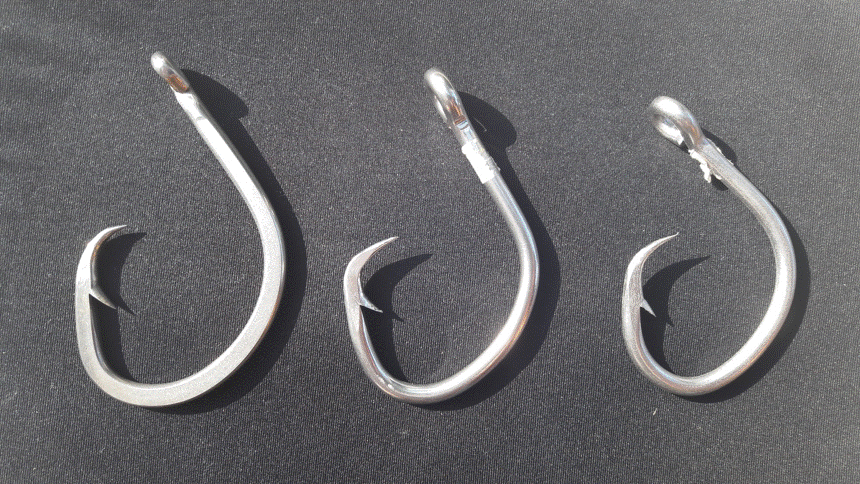
Incidental capture of sea turtles in pelagic and coastal fisheries (also called bycatch) is arguably the greatest threat to sea turtles worldwide. Yet, until recently, there was practically no information regarding sea turtle interactions with longline fisheries in the southwestern Atlantic Ocean. The first studies about this topic were made public by Uruguayan researchers in 1998, the same year that Brazilian researchers presented a report about the incidental capture of loggerhead turtles by longline vessels in Brazil. Although the government insisted that incidental capture was very low, Brazilian NGOs such as Projeto TAMAR asserted the opposite.

Why Europe Needs to Adopt Turtle Excluder Devices
TEDs are a simple but elegant solution for minimizing sea turtle bycatch in trawl fisheries. As such, they are now mandated by many governments around the world and their use is enforced. However, Europe, which is the largest market for fisheries products in the world, has no such regulation and provides an alternative market for countries that do not use TEDs.

Building Bycatch Solutions from the Ground Up for the East Pacific Leatherback
The East Pacific population of the leatherback is one of the world’s most threatened marine turtle regional management units, due in large part to bycatch of leatherbacks in foraging grounds. There may now be fewer than 1,000 adult females in this population owing to a combination of fisheries bycatch, egg harvesting, and other threats. As such, an expert working group was assembled to develop a 10-year regional action plan to halt and reverse the decline of the East Pacific leatherback turtle.

Action on Ghost Gear
Ghost gear—intentionally or unintentionally abandoned, lost, or otherwise discarded fishing gear—is a global conservation problem that affects dozens of marine species, including sea turtles. Ghost gear continues to catch target and non-target species long after being lost, abandoned, or discarded, a process called ghost fishing.

lluminating Innovations in Fisheries Technology Reduce Bycatch
Coastal gillnet fisheries are some of the most common fisheries throughout the world, and they play an important role in the food security, economics, and culture of coastal communities. Yet gillnet fisheries are often problematic because of their nonselective impact on the marine environment; they incidentally capture many nontarget species.