
Articles
Please use the filters and search bar below to find articles that have been published in SWOT Report. All past SWOT Report articles are also available as PDFs in the SWOT Report section of this site.
Filter by Tags
- Africa 18
- Arribada 1
- Asia 23
- Atlantic Ocean 36
- Atlas 10
- Australia 8
- Cabo Verde 1
- Caribbean Sea & Gulf of Mexico 28
- Climate Change 14
- Coastal Development 16
- Direct Take 31
- East Indian and Southeast Asia 1
- East Pacific 1
- Europe 8
- FAQs 14
- Fisheries Bycatch 26
- Flatback 3
- Genetics 1
- Global 90
- Grants 5
- Green turtle 37
- Hawksbill 30
- India 1
- Indian Ocean 23
- Indonesia 1
- Kemp's ridley 11
- Leatherback 30
- Loggerhead 34
- Mediterranean Sea 7
- Mexico 1
- North America 36
- North Atlantic 1
- Olive ridley 11
- Outreach and Action 8
- Pacific Ocean 46
- Plastic 2
- Policy and Economics 5
- Pollution and Pathogens 17
- Rescue and Rehabilitation 4
- Research and Status 8
- SWOT Team Update 1
- South America 26
- South Atlantic 1
- Southeast Asia 2
- Special Feature 21
- Tortoiseshell 2
- Trade 2
- West Indian Ocean 2
- West Pacific 1
Filter by SWOT Report
- Announcements 1
- Online Exclusive Articles 16
- SWOT Report vol. 1 15
- SWOT Report vol. 10 12
- SWOT Report vol. 11 10
- SWOT Report vol. 12 12
- SWOT Report vol. 13 15
- SWOT Report vol. 14 14
- SWOT Report vol. 15 13
- SWOT Report vol. 16 16
- SWOT Report vol. 17 15
- SWOT Report vol. 18 13
- SWOT Report vol. 19 20
- SWOT Report vol. 2 24
- SWOT Report vol. 20 14
- SWOT Report vol. 21 13
- SWOT Report vol. 3 18
- SWOT Report vol. 4 13
- SWOT Report vol. 5 13
- SWOT Report vol. 6 12
- SWOT Report vol. 7 13
- SWOT Report vol. 8 4
- SWOT Report vol. 9 18

Up “Grade” Your Volunteer Program with Academic Internships
Beyond enhancing the lives and careers of students, academic internships can also boost the success of a volunteer program while benefiting sea turtles and the nonprofits and local communities that work with them. Here are some tips for creating a successful academic internship program.

The True Value of Sea Turtles
The conversation around valuing nature is expanding quickly to include the cognitive, emotional, psychological, and social benefits that we know are real drivers of the human-nature relationship. When neuropsychologists and conservation biologists team up, the results can be revolutionary.

Turtle Recovery in Cyprus: The Importance of Long-Term Commitment
Local turtle champion Kutlay Keço has been watching green and loggerhead turtles nest on Alagadi Beach in northern Cyprus since the 1970s. Alarmed at the ever-increasing levels of nest predation by stray dogs, he invited two university students, Annette Broderick and Brendan Godley, to collaborate in surveying the population. In 1992, they established the Marine Turtle Conservation Project, documenting a 90 percent nest predation rate, and they set out to turn these unsustainable losses around.

A Tale of Two Beaches in Greece
The two largest aggregations of loggerhead sea turtles in the Mediterranean Sea, representing 27 percent of all loggerhead nesting in that basin, are in Greece: Laganas Bay on Zakynthos Island and Kyparissia Bay in western Peloponnese, with Laganas Bay historically considered the largest.

Costa Rica: A Superlative Sea Turtle Country
Costa Rica is a country of ocean, nature, and sea turtle superlatives. Five of the world’s seven species of sea turtles nest on its shores, a number exceeded only by the significantly larger countries of Australia and Mexico.

New Riddle in the Kemp’s Ridley Saga
Kemp’s ridleys evaded the notice of scientists until the late 1800s. Once discovered, scientists took nearly 100 years to find out where and how they reproduce. In the past five years, an unexplained precipitous population decline has scientists scrambling to solve yet another riddle, one that will determine if the future of this critically endangered species is again in jeopardy.
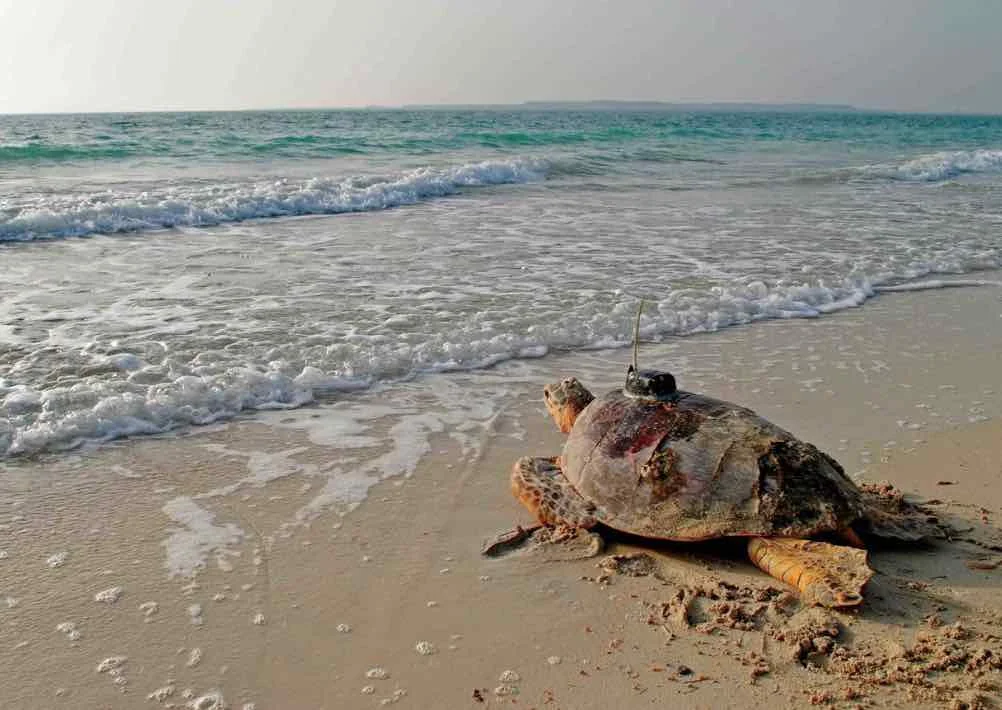
Important Turtle Areas in the Arabian Gulf
Knowing where turtles are in a particular life stage is a critical first step to defining Important Turtle Areas (ITAs), and recent advances in technology are allowing scientists across the planet to begin to unravel many of the mysteries of where turtles go while at sea. One area where this technology was recently applied with great results is the Arabian region, a part of the world not well known for its sea turtles.

A New Way to Tag
If you have ever worked on a sea turtle nesting beach project, then you have probably had the experience of snapping a metal tag to the trailing edge of a sea turtle’s flipper. In recent years a new genetic technique has emerged as an alternative to physical tagging.

Eyes in the Sky Help Sea Turtle Research
The use of small manned aircraft to perform aerial surveys has long been a standard practice in monitoring populations of marine megafauna. The higher the eye, the more it can see. But those flights are generally costly, and engine noise can adversely affect animals’ behavior during low flybys. Small, maneuverable, inexpensive, and no louder than the hum of a beehive, drones are beginning to provide an more powerful tool for researchers conducting aerial surveys.

Picture Perfect Photography for Turtle Monitoring
Recapturing sea turtles in the water requires significant resources, including watercraft, fuel, time, and people power, and it may also cause the turtles unnecessary stress. Finding a way to identify and re-identify turtles over time without the need to physically capture them could open up many possibilities for us and for hundreds of other projects that use similar techniques.