
YOUR JOURNEY STARTS HERE
Sea Turtle Volunteer Opportunities Worldwide
Powered by the State of the World’s Sea Turtles (SWOT) Program, the global Sea Turtle Directory connects you directly to nearly 500 conservation projects worldwide and allows you to filter by those that offer volunteer programs. Using the interactive map below, you can discover volunteer, internship, and tourism opportunities worldwide and connect with them directly to learn more about their volunteer programs and apply.
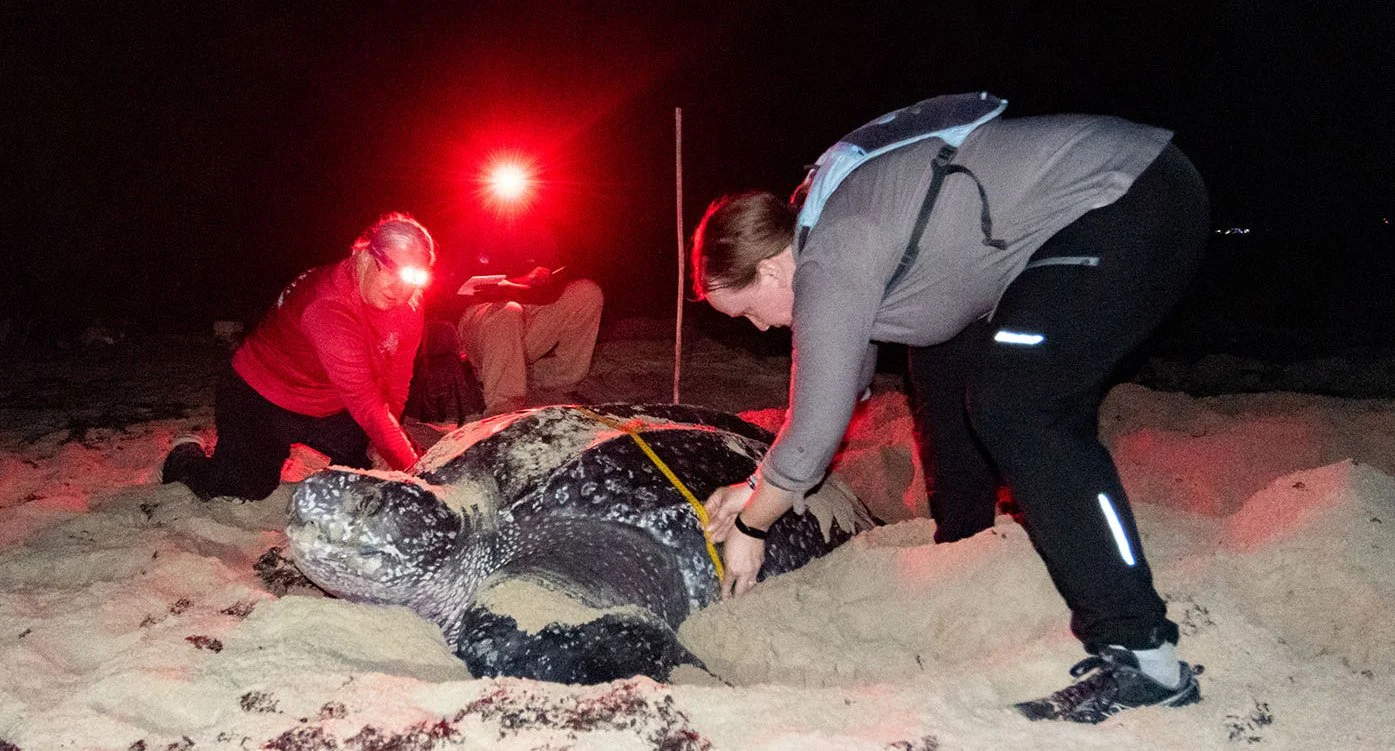
Volunteers measure a leatherback turtle at night on the shores of Trinidad. Sea turtle conservation projects worldwide rely on volunteers to carry out their important work. Volunteers gain valuable first-hand experience while helping protect sea turtles.
Every year, thousands of people around the world volunteer with sea turtle conservation programs to protect nesting and hatching turtles, collect valuable scientific data, and support community-based conservation efforts.
The Sea Turtle Directory, part of the State of the World’s Sea Turtles (SWOT) program, is a free tool that can help you find and learn about sea turtle volunteer opportunities, internships, or field programs. It is the most comprehensive global database of sea turtle projects available, with nearly 500 registered projects worldwide, and growing! Using the directory, you can explore organizations working to protect sea turtles and filter by: location, projects offering volunteer opportunities, sea turtle species, and more. Browse volunteer programs →
Explore Active Sea Turtle Volunteer Projects
Use the interactive map below to discover projects and connect directly with the organizations leading conservation efforts on the ground. Follow these three steps to find your perfect project.
Filter for Volunteering: The map below is pre-filtered to show only projects that offer Volunteer Opportunities.
Narrow Your Search: Use the filter menu at the bottom to filter by Species (e.g., green, hawksbill), Project Type (e.g., non-profit organization, university), Country, or Primary Areas of Work (e.g. nesting beach monitoring, environmental education).
Connect Directly: Click on a map pin to view the project’s profile. From there, you can visit their website or social media to contact them directly or send them an email if an address is provided.
Tip: On mobile, use two fingers to scroll or pinch to zoom on the map
Important Note: Projects are independently operated and their listings in the Sea Turtle Directory are independently maintained. The volunteer projects listed here are not vetted or endorsed by the State of the World’s Sea Turtles Program; we are offering this directory as a public service. Volunteers are encouraged to do their own due diligence about any projects listed. Please contact each organization directly for information about volunteering, internships, costs, and requirements.
How to Volunteer with Sea Turtles
Sea turtle conservation programs vary widely in structure, duration, and focus. Most programs operate seasonally during nesting periods, while others run year-round research and community initiatives. Start by exploring the map above to find projects that suit your interests and timeframe, then click through to explore their websites and social media to learn more about the volunteer opportunities they are offering. If you have questions or need information about how to apply, reach out directly using the contact information provided in their listing or on their website. Look for projects with clearly defined programs and goals. Remember that the projects listed here are not vetted or endorsed by the SWOT program, so we strongly encourage you to do your own diligence before applying.
Volunteer opportunities are often seasonal, but several locations offer year-round work. For that reason, it is best to check their websites for detailed information. Depending on the project you volunteer with and what is happening with sea turtles at that time of year, volunteer work might include:
🐢 Nest Monitoring and Beach Patrols
The most common sea turtle volunteering activity is nesting beach monitoring. This work is typically done at night, walking the beach under the moon and stars (rain or shine!), in search of nesting turtles or recently deposited clutches of eggs. Depending on the project, you may be collecting different types of data, like the number of turtles, nests, or eggs, as well as measuring turtles, tagging turtles (and recording existing tags), and even protecting eggs from poaching or predation, in some cases relocating them to a hatchery.
🐣 Hatchling Monitoring & Nest Excavation
Volunteers also often do nest excavations and monitor for hatching activity. Nest excavations are done after a nest has hatched by digging up the remaining contents of the nest to: a) release any hatchlings that didn’t make it out with the rest of the clutch, b) collect data about other nest remains, like egg shells, unhatched eggs, or dead turtles. For projects with hatcheries (areas to which nests are relocated for protection), you might also monitor for hatching activity and release hatchlings.
📊 Research Assistance
Most sea turtle conservation projects undertake research to better understand the status of sea turtles and inform conservation efforts (like nesting beach monitoring), and along with this come a variety of volunteer tasks, including ongoing data entry and database management. Other research efforts that volunteers help with may include applying (and recording) metal flipper tags, applying (and reading/recording) microchip (PIT) tags, and in some rare cases, applying satellite tags. Some projects also lead boat based in-water research programs, or do related research like habitat mapping or monitoring, nest temperature recording, and much more. Volunteers help with all different types of sea turtle research!
🌊 Marine Debris Removal & Habitat Restoration
With ocean plastic pollution on the rise globally, many sea turtle nesting beaches are impacted by marine debris that washes ashore. Volunteers may assist with removing plastic pollution from nesting beaches and coastal habitats, and may participate in community cleanup efforts, recycling and upcycling programs, and other efforts to reduce the impacts of plastic pollution on sea turtles.
🤝 Community Outreach & Education
Effective conservation programs require the support of and close collaboration with the local communities that live near sea turtles and their habitats. Volunteers often work on community outreach activities, which may include delivering environmental education programs in local schools, leading workshops or field trips, and more.
Other Tasks
Part of the fun of volunteering with sea turtles is that there are many different types of work that volunteers can participate in, allowing them to work on projects that match their existing skills and interests, as well as learn and practice new skills. Volunteer tasks can include just about anything, from construction and maintenance, to gardening, sign painting, hatchery maintenance, creating social media content, writing grant reports and proposals, providing website support, and so much more.
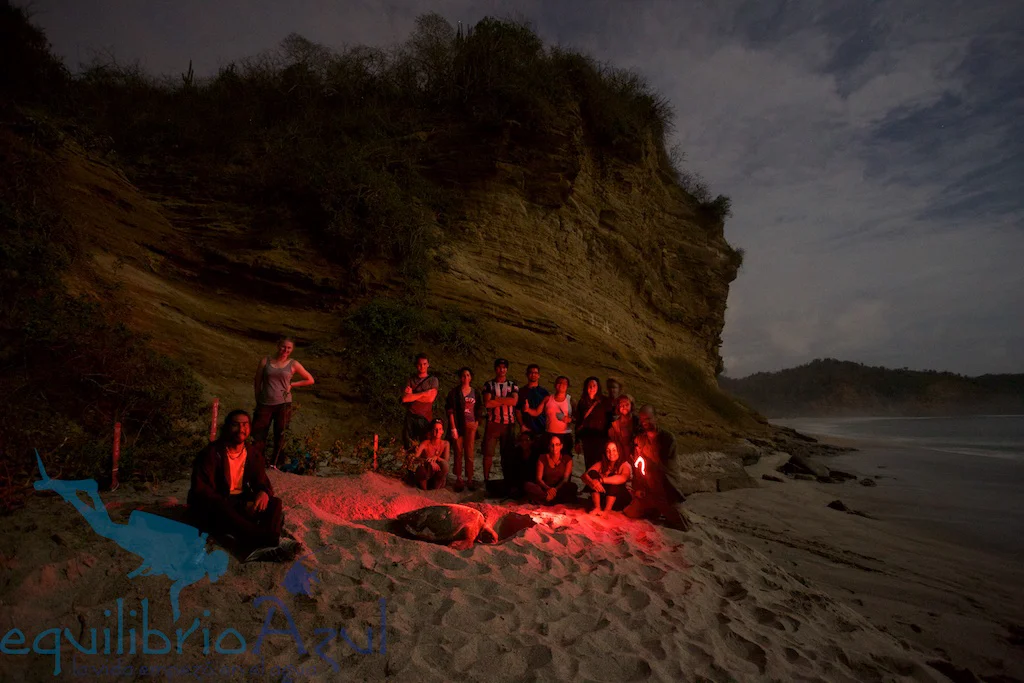
Volunteers with Equilibrio Azul pose with a hawksbill turtle after fitting it with a satellite tag on La Playita Beach in Machalilla National Park, Ecuador. © FELIPE VALLEJO / WWW.EQUILIBRIOAZUL.ORG
Where Can You Volunteer with Sea Turtles?
Sea turtles nest and forage across tropical and subtropical regions worldwide. Popular regions for sea turtle conservation volunteering include:
The Americas
There are many sea turtle volunteer projects throughout Central America, including in Costa Rica, Guatemala, Nicaragua, Panama, and Mexico, on both the Pacific and Atlantic (Caribbean) coasts. This region hosts globally important nesting beaches and ocean habitats for olive ridley, leatherback, green, and hawksbill turtles.
South America is also home to both nesting and foraging sea turtles on both coasts. On the Atlantic, volunteer projects can be found as far south as Argentina and Uruguay, as well as in Brazil, French Guiana, and Colombia. On the Pacific, there are several volunteer programs in Peru, Ecuador, and Colombia, where sea turtles both feed and nest.
The United States is also a stronghold for sea turtles, with major sea turtle nesting occuring throughout Florida and the southeastern U.S. Regulated volunteer programs are found in the Carolinas, Georgia, Florida, and Texas, and even in northern states like New York, especially during stranding season. On the west coast, southern California is home to foraging sea turtles, and there are several volunteer opportunities available.
Leatherback turtles even migrate as far north as Nova Scotia, Canada, where the Canadian Sea Turtle Network offers a range of volunteer opportunities!
The Caribbean
Sea turtles are widespread throughout the Caribbean region, and so are volunteer opportunities, with projects in Grenada, Puerto Rico, the Virgin Islands, Dominica, Guadeloupe, Antigua & Barbuda, Trinidad & Tobago, Curaçao, and more. Green turtles, leatherbacks, and hawksbills are the most widespread, and volunteer programs offer many different types of work.
The Mediterranean
Some of the longest running sea turtle conservation programs are found in the Mediterranean, and volunteer opportunities are available in Greece, Cyprus, and Turkey, which host key nesting areas for loggerhead and green turtles, as well as in Spain, Tunisia, Israel, and elsewhere.
Southeast Asia
Sea turtles are widespread in Southeast Asia, and there are numerous volunteer opportunities in Indonesia, Malaysia, and the Philippines, primarily focused on protecting hawksbill and green turtle nesting sites in the Coral Triangle region.
Australia
Queensland, Northern Territory, and Western Australia support important loggerhead, green, and flatback turtle rookeries, and a range of volunteer opportunities are available across Australia.
Indian Ocean & East Africa
There are many excellent sea turtle conservation projects in the Indian Ocean & East Africa that are supported by volunteer programs, including in Kenya, the Maldives, Tanzania, Mayotte, Sri Lanka, India, Bangladesh, and elsewhere, with programs focusing on a range of activities that includes nesting beach protection, community development, plastic waste management, marine habitat conservation, and more.
West & Central Africa
There are dozens of conservation projects based along the western African cost from Senegal to Angola, as well as in offshore islands like Bioko Island (Equatorial Guinea) and Cabo Verde. Volunteer opportunities are found in Senegal, Liberia, Ivory Coast, Ghana, Cameroon, Congo, and Angola.
Pacific Islands
The vast Pacific Islands region offers many opportunities to volunteer with sea turtles, from Hawai’i (U.S.) to Tonga, Fiji, and beyond.
Use the directory map above to filter projects by location and species.
FAQs About Volunteering With Sea Turtles
Do sea turtle volunteer programs cost money?
The short answer is that yes, most sea turtle volunteer programs do cost money, and typically that money goes to providing you with lodging, training/supervision, and often food (this obviously does not apply to volunteering that you might do in the area you live, which normally does not cost money). Sea turtle conservation projects typically operate with very limited funding, and having volunteers pay their own way is an important part of the equation.
In some cases, more experienced volunteers can secure volunteer leadership positions that come with free room and board, and/or modest pay. These positions are more limited.
Do I need experience To volunteer?
In most cases, no experience is necessary to volunteer with sea turtles. Volunteers are typically trained on site as part of their volunteer program.
When is nesting season?
Nesting seasons vary widely by location and species. As a general guideline, the further north you go, the more the nesting seasons will align with boreal summer (June - August), and the further south you go, the more they will align with austral summer (December - February). However, sea turtles nest year round in many places, tropical locations don’t have pronounced seasons, and different sea turtle species can have different seasons at the same nesting beach, so it is best to look for location specific information.
Where can I learn more about sea turtles?
We have been publishing and sharing educational information about sea turtles for more than 20 years. For a high level overview all about sea turtles, check out our Ultimate Guide to Sea Turtles, which includes links to many more in depth sources of information.
Here are links to our most popular resources:
Are You A Volunteer Project Leader?
If your volunteer project isn't listed or your volunteer status has changed, help us keep the world's best directory accurate by submitting or updating your project listing.