
Costa Rica’s Newest Arribada Beach Faces an Uncertain Future
By Sonia Gutiérrez Parejo, Ninive Rodríguez-Espinoza, Daniel Arauz Naranjo, Isabel Naranjo, Randall Arauza, Daniela Rojas-Cañizales, and Roldán A. Valverde
In Corozalito, Costa Rica, the sound of cars rolling toward the beach just before sunrise signals the final moments of the previous night’s arribada—the synchronized emergence of thousands of nesting olive ridley turtles. Corozalito’s residents arrive at the beach for their morning ritual, unaware of the frenzy that unfolded in the dark just hours before. Soon after, folding chairs and playful children share the beach with the few remaining turtles, scavenging vultures, and scattered eggs. The scene feels timeless, like a tradition forged across generations. Yet its origins are surprisingly recent. Arribadas began in Corozalito in 2011, sparking a remarkable transformation at this small, isolated beach on Costa Rica’s north Pacific coast.
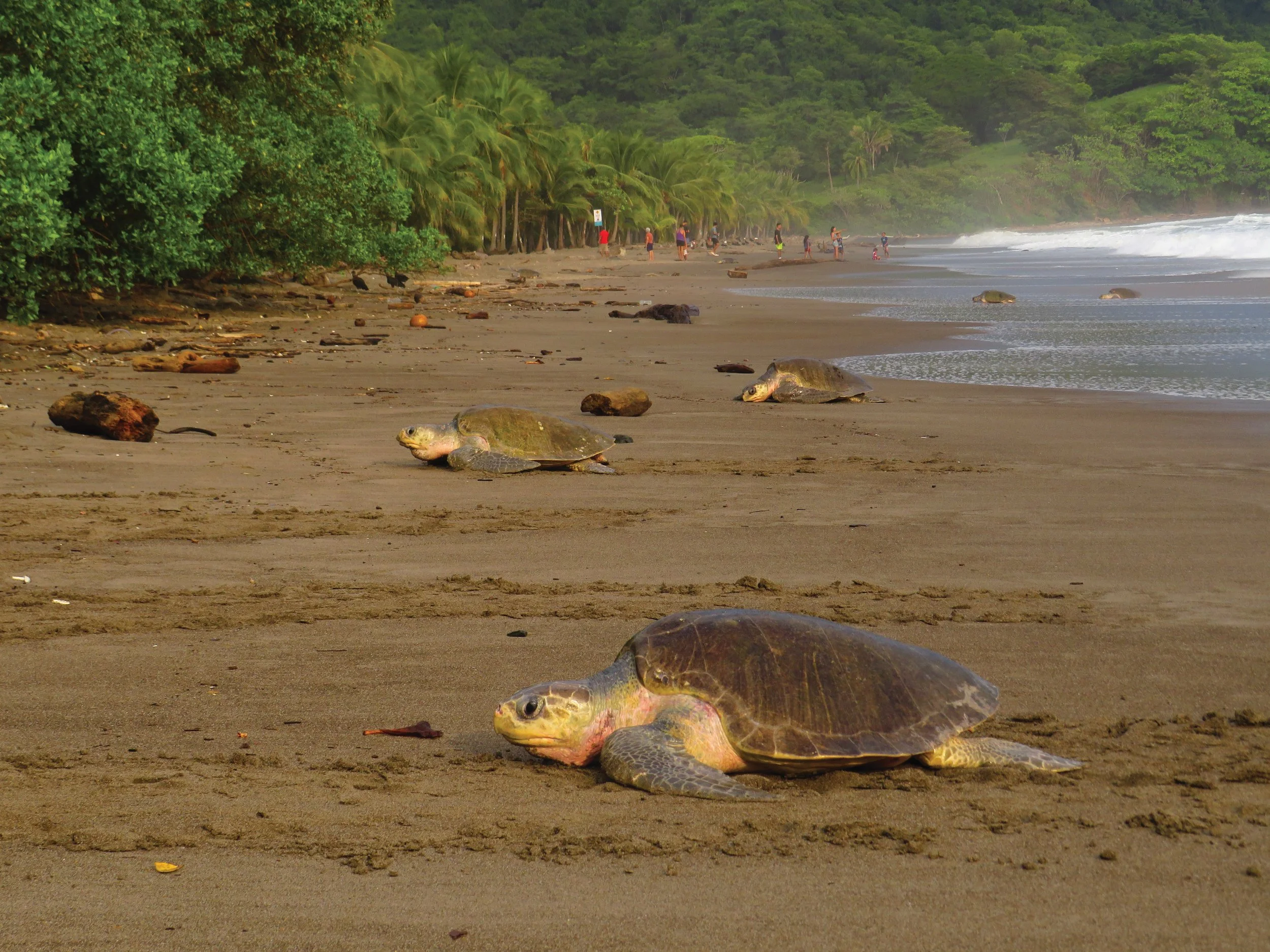
Olive ridleys crawl ashore to nest on Corozalito beach on Costa Rica’s north Pacific coast. Arribadas (mass nesting events) began here in 2011 and have since increased in frequency, creating both opportunities and challenges for local residents. © Eli Bianchi
In 2008, the Rescue Center for Endangered Marine Species (Centro de Rescate de Especies Marinas Amenazadas, or CREMA) began monitoring sea turtle nesting in Corozalito and documented a steady rise in nesting abundance. In 2011, the first official arribada occurred. What began as a rare phenomenon grew to be a regular event. First there was one arribada per year, then two, then three, and eventually, in 2025, six—a new record. This increased frequency has led the scientific community to recognize Corozalito as Costa Rica’s third arribada beach, joining the established sites at Nancite and Ostional.
Despite Corozalito’s mere 768 meters (about half a mile) of coastline, it hosts an ever-increasing number of female olive ridleys during each arribada. In October 2021, more than 20,000 nesting females emerged, the largest arribada ever recorded on the beach. Questions have been raised about whether this tiny beach can continue to sustain such large numbers of nesting turtles. Will the beach follow the boom-and-bust pattern seen at Nancite, which experienced dramatic declines after periods of intense nesting? Or will it sustain a robust population as at Ostional, where arribadas have persisted for decades?
Questions about Corozalito’s future extend beyond biology as well. The arribada phenomenon has drawn more visitors to the community, and residents worry about whether Corozalito—still a small rural town—is prepared to support, regulate, and ultimately benefit from the tourism influx. While increased visitation brings the potential for new livelihoods, it also risks overwhelming the community’s limited infrastructure and disrupting social and environmental systems.
The Long Shadow of Ostional
As sea turtles have gained global attention and protection, Costa Rica’s coastal communities have increasingly looked to Ostional for guidance, because it is home to the country’s oldest recorded arribadas. Starting in the 1950s, locals illegally harvested eggs from nests at Ostional on a massive scale to supplement their income. Then, in 1984, the Costa Rican government granted a legal exception that allows Ostional community members to collect a portion of eggs during the early stages of each arribada. Many scientists support this system, citing the naturally low hatching success of eggs laid during the beginning of densely packed nesting events because of microbial loads and destruction by subsequent females. For decades, Ostional’s model has been held up as a global case study, so it is no surprise that Corozalito looks to it now as it navigates its own future.
What Divides Them
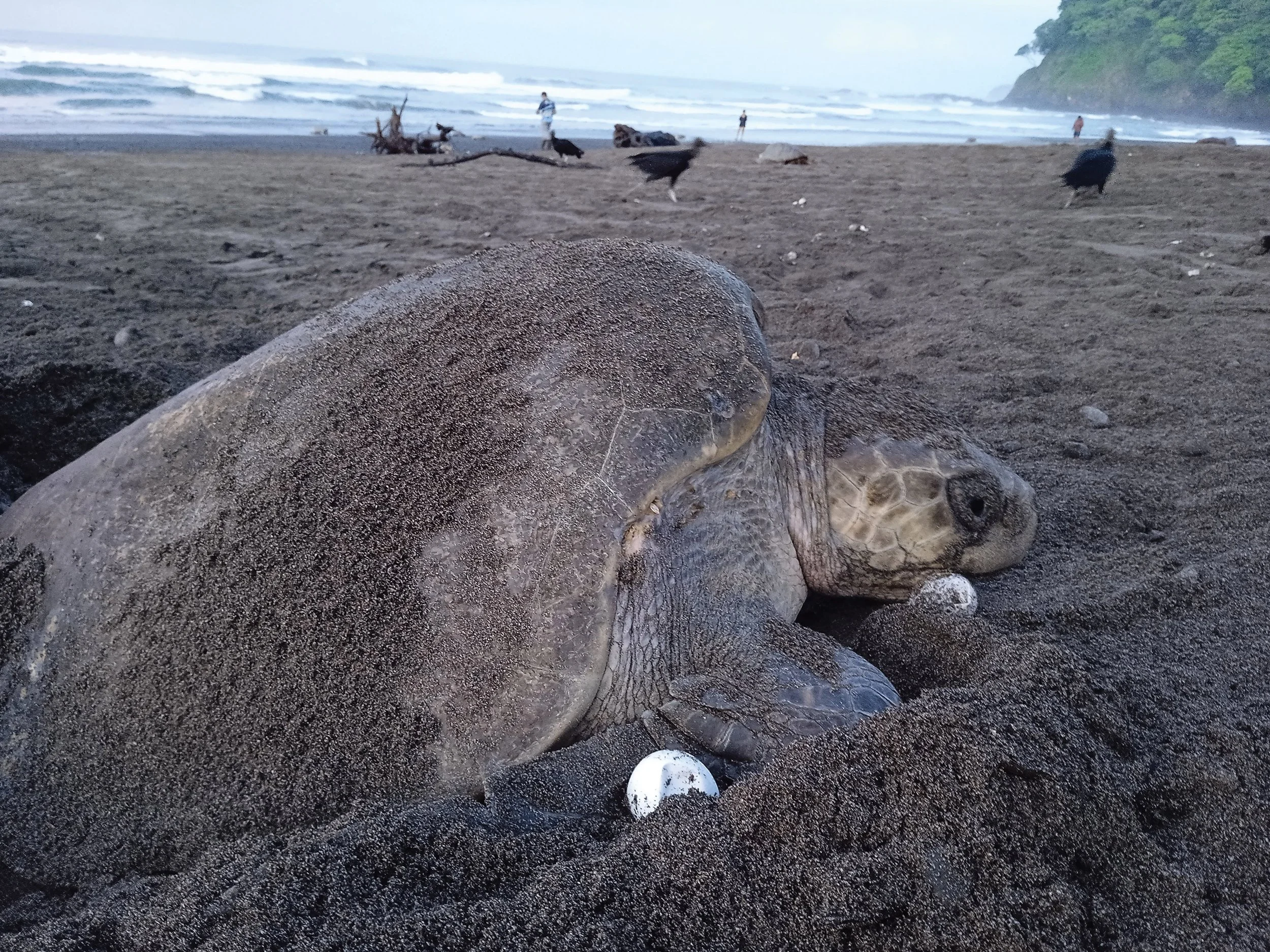
An olive ridley nests during an arribada on Corozalito. © Eli Bianchi
The debates unfolding in Corozalito echo generational divides seen worldwide. Younger residents, who have been educated in a modern context of environmental awareness and conservation norms, face an uncertain economic landscape and often feel excluded from community decisionmaking. Elders, who hold influence over local governance and traditions, are more resistant to change.
These tensions were first captured during a series of interviews led by researcher Carmen Mejías-Balsalobre and colleagues in 2018. Younger participants expressed total opposition to egg extraction, whether legal or illegal. Elders, however, were more open to controlled subsistence use and even commercialization, citing Ostional’s long-standing model as an example to follow. This disagreement has fueled years of internal conflict, with residents torn between conservation values, economic pressures, and questions of identity and autonomy.
What Unites Them
Despite disagreements over egg harvest, Corozalito residents share an overwhelming consensus on one point: support for well-regulated, turtle-focused tourism is needed, especially given that outside investors have been rapidly acquiring land and initiating development projects. Signs advertising property for future tourist ventures now line the roads, and gas stations have arisen seemingly from nowhere. Wealthy landowners and outside investors are far better positioned to thrive in this emerging economy, while many locals fear being left behind.
Other coastal communities, such as nearby Playa Grande, offer sobering examples of what could come. There, longtime residents were priced out of their own towns, pushed aside as land speculation and tourism intensified. As living costs rise, some in Corozalito worry that economic desperation could revive the once-persistent illegal egg harvest.
Adding urgency to these concerns is Corozalito’s lack of formal protection for its wildlife and natural ecosystems. Unlike Nancite, a national park, or Ostional, a national wildlife refuge, Corozalito remains legally vulnerable to exploitation. Today, CREMA and the Asociación de Desarrollo Integral de Corozalito (ADICOR), with support from the Riester Foundation and local guides, are working to steer the community toward a sustainable future—one that balances conservation, livelihoods, and cultural integrity.
Achieving that vision will require partnership. The community, nongovernmental organizations, and environmental authorities must work together to secure legal protection, manage tourism, and safeguard both the turtles and the people whose lives are intertwined with the extraordinary arribadas.
This article originally appeared in SWOT Report, vol. 21 (2026). Download the full report as a PDF.