
Pacific Leatherback Monitoring Drives Oceanwide Conservation Planning
By George Shillinger, Helen Bailey, Steven Bograd, John Douglas, Matthew R. Dunn, Peter Dutton, Tomoharu Eguchi, Kayla Fisher, Brittany Finucci, Karin Forney, Sierra Fullmer, Alexander R. Gaos, Richard Hamilton, Heather S. Harris, Elliott L. Hazen, Erin L. LaCasella, Garrett Lemons, Dong Liang, Samuel Malagon, Duane March, Andrew S. Maurer, Karen L. Middlemiss, Anna Ortega, Kristin Reed, Richard Reina, Kayla Sargent, Jeffrey A. Seminoff, Peter Waldie, Heather Welch, Sean Williamson, and Scott R. Benson
Standing on the bow of the Sheila B., researchers scan the ocean’s surface for the glint of a leatherback carapace. Even though they are the largest sea turtle species, spotting one in the open Pacific can feel like searching for a needle in an ocean of haystacks. Fortunately, the crew isn’t alone. Overhead, an aerial survey team searches from an altitude of 650 feet, using radios to direct the vessel team toward any leatherbacks the team spots.
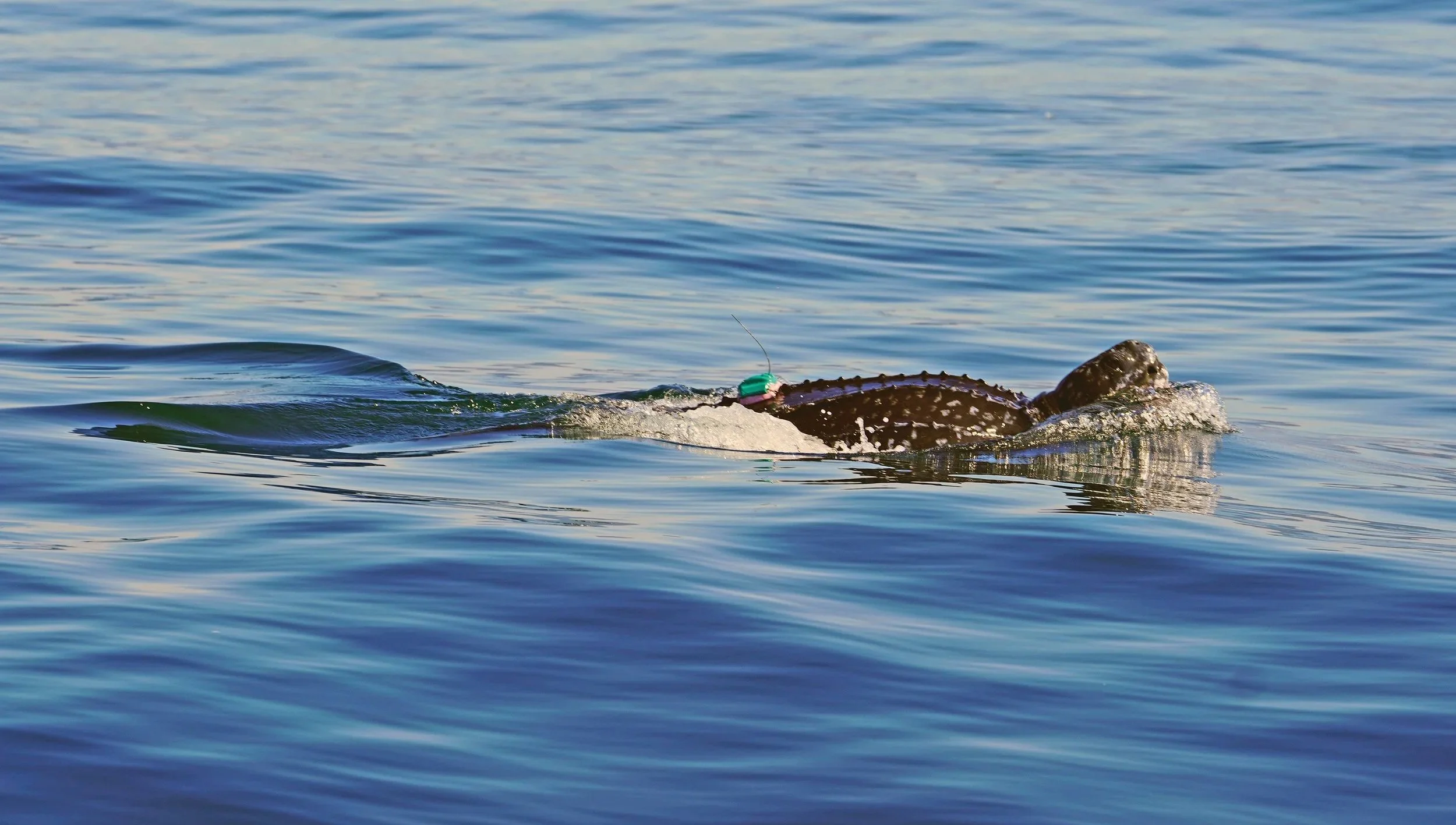
A leatherback turtle with a satellite transmitter attached swims off the coast of California, U.S.A., a critical feeding area for leatherbacks from the western Pacific. © George Shillinge/NOAA Permit #21111
This teamwork enables the researchers to locate and net these ocean giants one by one, bringing them on board to conduct a health assessment and attach satellite and acoustic tracking tags to each turtle’s carapace. Once the flurry of activity is complete, the turtle is released back into California coastal waters to continue its journey, feeding on jellyfish, tunicates, and salps as it goes.
Since 2000, the U.S. National Oceanic and Atmospheric Administration (NOAA) has been monitoring leatherbacks off California. In 2019, the U.S.-based nongovernmental organization Upwell Turtles joined the effort and in 2022 led the expansion of the work into Oregon and Washington. Scientists have now tagged more than 100 leatherbacks off California’s Central Coast, collecting telemetry and health assessment data, along with aerial survey data for multiple species. Through collaborations with state and federal agencies, the data are mobilized to inform conservation policy, providing insights that support protections for leatherbacks in U.S. waters, including critical habitat designations and guidance on fishery operations.
Monitoring efforts in California wrap up each year in November when the leatherbacks migrate back to waters adjacent to nesting beaches in Indonesia, Papua New Guinea, the Solomon Islands, and Vanuatu. We discovered these migration paths thanks to telemetry research conducted in the early 2000s that revealed two distinct subpopulations nesting in the West Pacific: one population nesting from June to August that forages primarily in the North Pacific, and the other population nesting from December to February that forages primarily in the waters of Australia and New Zealand.
Those vast migrations from beach to foraging grounds expose leatherbacks to threats at every turn. They can become entangled in ghost nets, hooked on longlines, struck by vessels, or starve after ingesting plastic that blocks their intestines. According to the International Union for Conservation of Nature (IUCN) Marine Turtle Specialist Group’s Conservation Priorities Portfolio (see SWOT Report, vol. XX, “An Atlas of Global Sea Turtle Status 2025”), West Pacific leatherbacks are among the most threatened and at-risk sea turtles in the world. The population has declined by more than 80 percent in the past 40 years, and fisheries interactions in the waters of many nations and on the high seas are a primary driver. Protecting leatherbacks means ensuring that they are safe throughout their entire migration, which makes international collaboration key to their recovery.
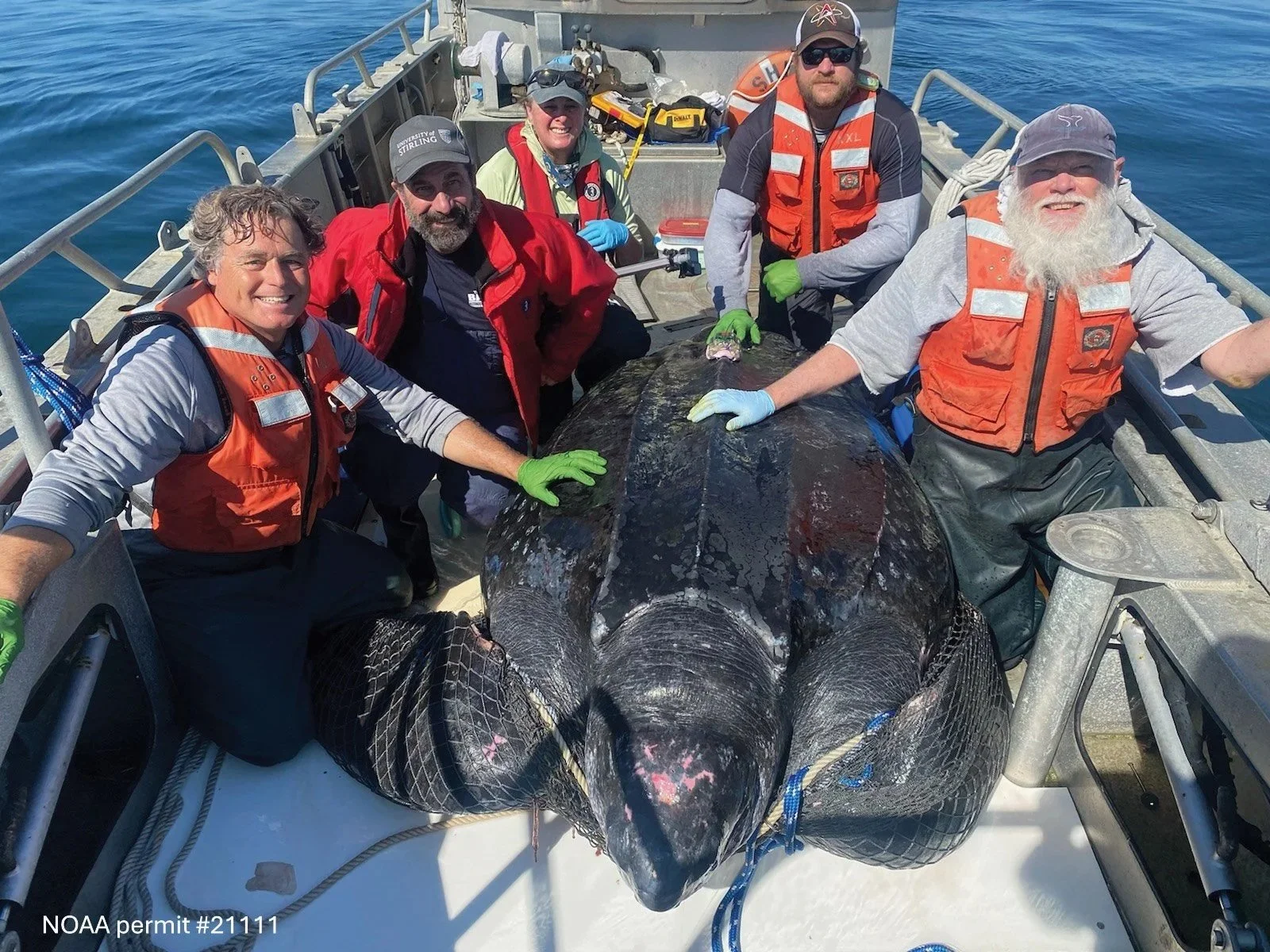
Researchers on board the Sheila B. pose with a leatherback turtle that was tagged near Moss Landing, California, U.S.A. Data collected from the turtle’s tag was used to inform conservation policy in U.S. waters and beyond. © Heather S. Harris/NOAA Permit #21111
In 2024, Upwell and NOAA joined forces with New Zealand’s Department of Conservation and National Institute of Water and Atmospheric Research, and with Monash University (in Australia), to launch the first aerial surveys and to conduct mock capture exercises targeting leatherbacks in New Zealand’s foraging grounds. This fieldwork, initiated in 2025, laid the foundation for future surveys and vessel-based tagging efforts aimed at informing regional management and conservation decisions.
As partnerships grow across the Pacific to collect more data, the next step is to mobilize this new knowledge to support conservation strategies. In 2025, Upwell and Monash University developed an integrated species distribution model (iSDM) and a corresponding risk management tool (RMT) for leatherbacks in Australia and New Zealand’s waters. The project was carried out with support from the New South Wales Department of Climate Change, Energy, the Environment, and Water under the Marine Estate Management Strategy.
The current beta versions of iSDMs and RMTs use data on leatherbacks, fisheries, and oceanographic conditions to create an algorithm that predicts where leatherbacks are most likely to be. These predictions update as ocean conditions change, offering a dynamic tool that could be used to protect leatherbacks in near real time. Imagine, for example, fisheries managers having access to this information in the form of a map showing areas to avoid leatherback bycatch and using it in their decision making processes.
The more data an algorithm has, the more accurate its predictions can be. As such, the aforementioned partners are working to strengthen the accuracy of the iSDM and RMT tools by amassing data from an ever-broadening coalition of partners in places such as Indonesia (World Wildlife Fund), the Solomon Islands (The Nature Conservancy), and New Zealand (Ministry for Primary Industries, Department of Conservation).
These Pacific-wide efforts to collect data, forge partnerships, and develop new conservation tools are helping to create an adaptive management framework that could bolster traditional fisheries bycatch mitigation measures. While there is further work to be done to put adaptive management tools like iSDMs and RMTs into daily action, these tools offer hope to allow fishers to sustain their livelihoods while mitigating their impact on leatherbacks.
Back on the California coast, Upwell and NOAA tagged a leatherback in 2025 and named it Ricky Ricardo in honor of the late leatherback researcher Ricardo Tapilatu (1966–2022). Tracking data revealed that after spending a month foraging in U.S. waters, Ricky began a trans-Pacific migration. Protecting leatherbacks during a journey as vast as Ricky’s is a monumental challenge—one that will benefit from both traditional conservation measures and the adaptive management tools described earlier. Leatherbacks have roamed the seas for more than 100 million years, but today their future depends on our collective ability to share knowledge, resources, and responsibility to ensure that the oceans are somewhere they can thrive.
This article originally appeared in SWOT Report, vol. 21 (2026). Download the full report as a PDF.