
Strengthening Collaboration for Hawksbill Protection
By The Steering Group for the Hawksbill Single Species Action Plan and the Convention on the Conservation of Migratory Species (CMS) IOSEA Marine Turtle MoU Secretariat
A First-Ever Multinational Approach
The critically endangered hawksbill turtle faces mounting threats from illegal trade, overexploitation, habitat loss, bycatch, and climate change throughout its global range, and these hazards are particularly intense in the waters of several Southeast Asian and western Pacific countries. To address these issues, a hemispheric effort is under way to bring together 33 Range States to develop a collaborative policy instrument to protect the species. The initiative falls under the Convention on the Conservation of Migratory Species (CMS) and is known as the Indian Ocean–South-East Asian (IOSEA) Marine Turtle Memorandum of Understanding (MoU). Under this intergovernmental agreement, a Single Species Action Plan (SSAP) for the hawksbill turtle in Southeast Asia and the western Pacific Ocean has been developed.
The commitments under the SSAP apply throughout the region it covers, including to each Range State’s area of jurisdiction and to any Range State’s flag vessels that engage in the exploitation of hawksbills in international waters. As of mid-2025, 16 countries had formally adopted the SSAP, and 8 countries had already reported on their progress in implementing its requirements. Drawing from those reports, this article explores what is working, where challenges remain, and which priority actions are most urgent now.
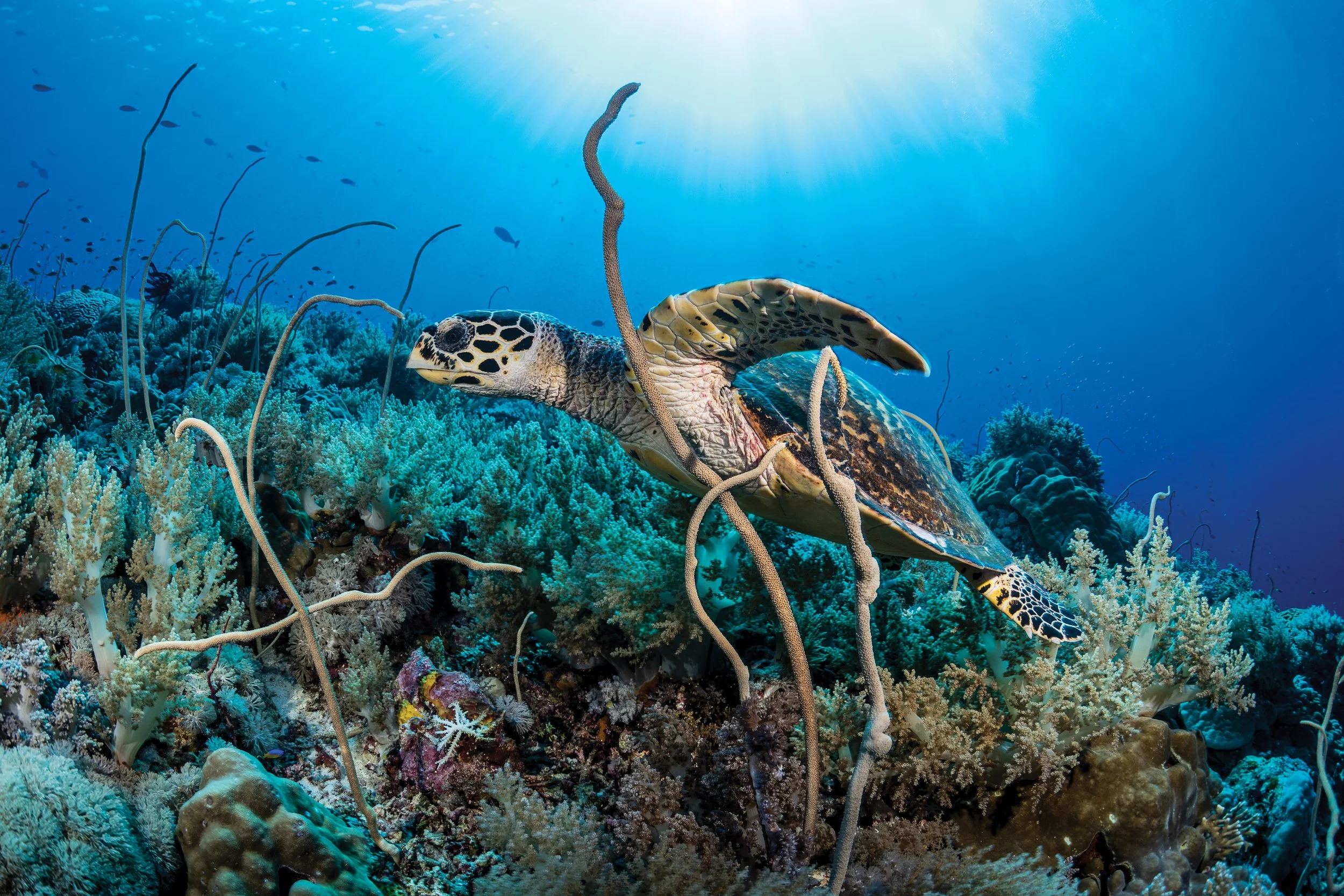
A hawksbill turtle swims amid the lush coral of Jessie Beazley Reef in Tubbataha, Philippines. © Noel Guevara
Turning Commitments into Action
A June 2025 progress report revealed encouraging steps by several Range States toward implementing the hawksbill turtle SSAP. Most notably, reporting governments showed advances in strengthening the criminal justice response to illegal activities involving hawksbills. In Australia, fines and prison terms for offenses involving marine turtles tripled, all while rights under the Native Title Act were protected. Similarly, in Thailand, the maximum imprisonment time for hunting, trading, and possession of protected marine wildlife was extended from 4 years to 10–15 years, and fines were increased 40-fold. And in Malaysia and the Philippines, the United Nations Office on Drugs and Crime Rapid Reference Guide is being used to support the prosecution of wildlife crimes in those countries. Across many Range States, the harvest of hawksbill turtles, including their eggs, is now outlawed, marking a significant step toward reducing direct human pressures on the species. Some carefully regulated exceptions remain for traditional and indigenous use, as well as for scientific research.
Other important successes include legislative reforms that strengthen protections for hawksbill turtles and efforts to close legal loopholes in the enforcement of international commitments. Thailand, for instance, now lists the hawksbill turtle as a protected species under its Wild Animal Conservation and Protection Act, which means that import and export of the species are strictly controlled. Likewise, the United States reports that it is illegal to import, export, or take any endangered species, including the hawksbill, for any purpose, commercial or otherwise.
Beyond new laws, several countries are also investing in capacity building, thereby bolstering the people and institutions charged with enforcing the laws. Between 2023 and 2024, wildlife officers in the Philippines participated in an ambitious series of training workshops and courses focused on tackling transnational organized crime and improving the monitoring of environmental offenses. Fiji, meanwhile, trained and appointed fish wardens and expanded cross-agency enforcement programs. Such efforts signal a shift toward stronger, better-equipped frontline protection for hawksbill turtles across the region.
Closing the Gaps
Despite the progress reported, major gaps remain, and many key issues have not been fully addressed yet, including shortfalls in membership and reporting. Some of the most notable missing actions concern addressing illicit financial flows and corruption linked to turtle trafficking, though some countries reported having undertaken relevant actions on this topic. For example, Malaysia highlighted its participation in the Association of Southeast Asian Nations Wildlife Enforcement Network, which aims to improve intelligence sharing and coordinate joint operations. Such efforts help countries better understand community motivations for using hawksbill turtles while promoting sustainable alternatives.
However, the major impediment to implementation of the SSAP and to hawksbill conservation overall is the scarcity of funding and technical expertise, which hinders interregional collaboration to curb illegal take and trade and limits actions to effectively address sea turtle bycatch by illegal, unreported, and unregulated (IUU) fishing. IUU fishing is a severe threat to hawksbills and is exacerbated by high levels of bycatch and targeted take, particularly in small-scale fisheries, which are widespread.
The Range States must invest more in capacity building to ensure that their people have the necessary skills to deliver on the SSAP’s ambitious goals. Hence, the signatories of the IOSEA Marine Turtle MoU have endorsed the development of a capacity-building strategy to design an appropriate way to address the region’s most pressing needs. Recommendations to further strengthen implementation, based on the challenges reported by the Range States, will be discussed at the 15th Meeting of the CMS Conference of the Parties (CMS COP15), in March 2026, in Campo Grande, Brazil.
Conservation efforts are ongoing and improving in this vast region, offering many reasons for hope. By weaving together past achievements, understanding difficulties, and addressing unresolved priorities, the region aims to take tangible steps to secure a future for hawksbill turtles.
This article originally appeared in SWOT Report, vol. 21 (2026). Download the full report as a PDF.