
African Experts Map World’s First Important Marine Turtle Areas
By Alexandre Girard and Brendan Hurley
An Unprecedented African-Led Effort
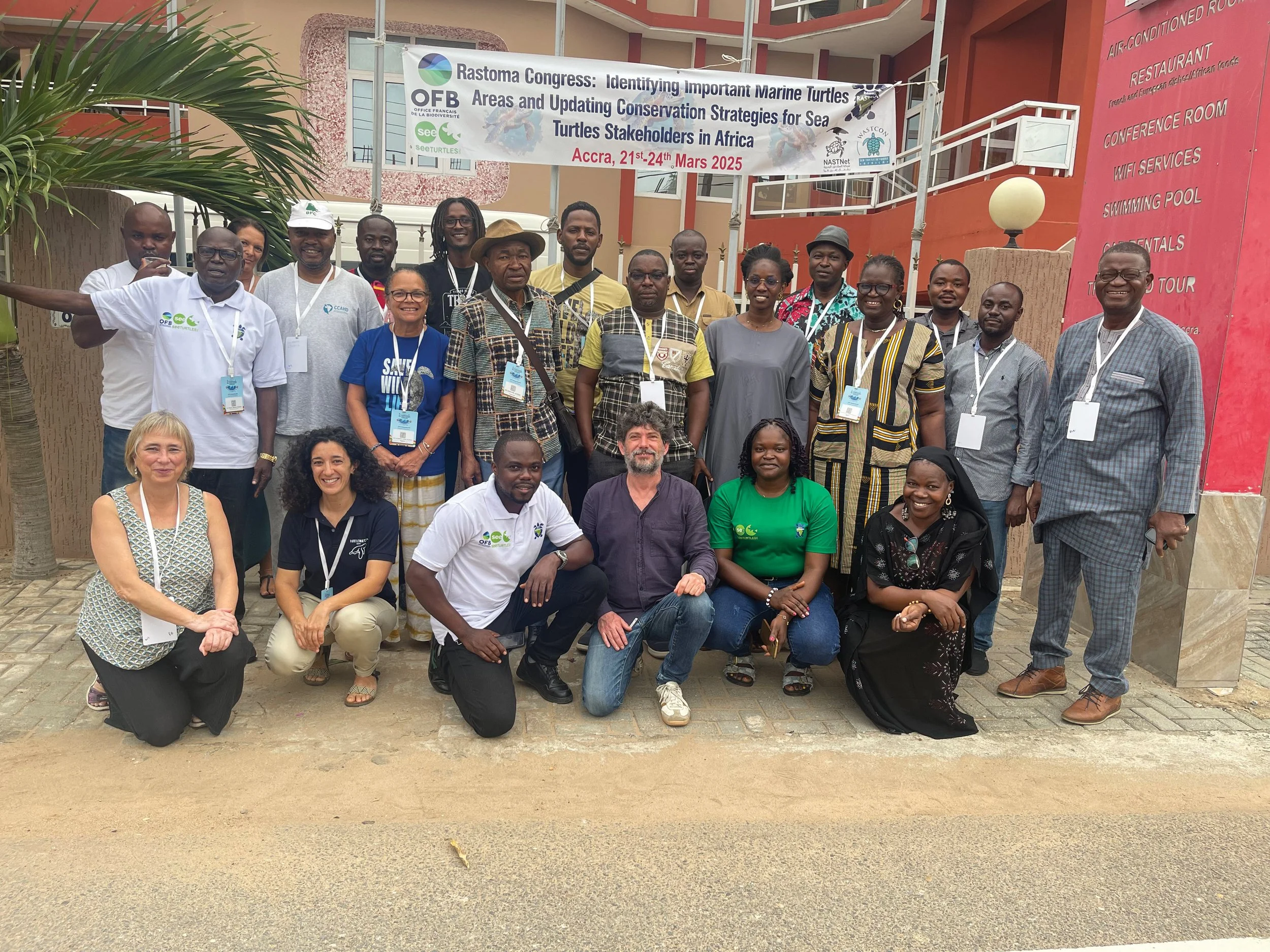
At a March 2025 workshop in Accra, Ghana, more than 40 attendees from 14 countries took the first steps toward identifying proposed Important Marine Turtle Areas (IMTAs) in West and Central Africa, resulting in more than 35 proposals. © Alexandre Girard
In recent years, African sea turtle conservationists have organized themselves into three important regional networks. RASTOMA was the first network established, and it represents the central western countries of the continent (Cameroon, the Democratic Republic of Congo, Equatorial Guinea, Gabon, the Republic of Congo, and São Tomé and Príncipe). WASTCON (West African Sea Turtle Conservation) was the second group to be organized, and it represents the countries of Benin, Côte d’Ivoire, Ghana, Guinea, Liberia, Nigeria, Sierra Leone, and Togo. More recently, NAST-Net (North Africa Sea Turtle Network) was created to represent the northern African countries of Algeria, Egypt, Libya, Morocco, and Tunisia. The three networks meet regularly to support the work of their members and to ensure that their regions, and Africa as a whole, are well represented regionally and globally in important sea turtle conservation initiatives, such as those led by the International Union for Conservation of Nature (IUCN) Marine Turtle Specialist Group (MTSG) and SWOT.
The MTSG developed the Important Marine Turtle Area (IMTA) concept to identify and prioritize sites critical to marine turtle populations worldwide. Although the IMTA concept has been formalized and recognized by the expert community, it had not previously been applied in practice to any region in the world. Therefore, the RASTOMA network took the initiative to gather representatives from 10 of its member institutions at the 43rd International Sea Turtle Symposium in Accra, Ghana, in March 2025, to identify African IMTAs. The RASTOMA representatives were joined by colleagues from WASTCON and NAST-Net for a workshop in which members reviewed IMTA criteria and discussed the process to propose putative IMTAs.
This pilot project is the first effort to translate the IMTA concept into African-led conservation action and to map key habitats, document local knowledge, and create a shared dataset to serve scientists, policymakers, nations, and local communities as they engage in decision making related to sea turtle conservation. Joining the effort was Dr. Brendan Hurley from the George Washington University (U.S.A.), an earth systems and geoinformation sciences specialist who had participated in past efforts to georeference and manage sea turtle biogeography information for conservation purposes, including the development of the regional management unit framework led by the MTSG. Funding for the Ghana IMTA workshop was provided by the Office Français de la Bodiversité, SWOT, and others.
A Regionwide Effort Rooted in Local Knowledge
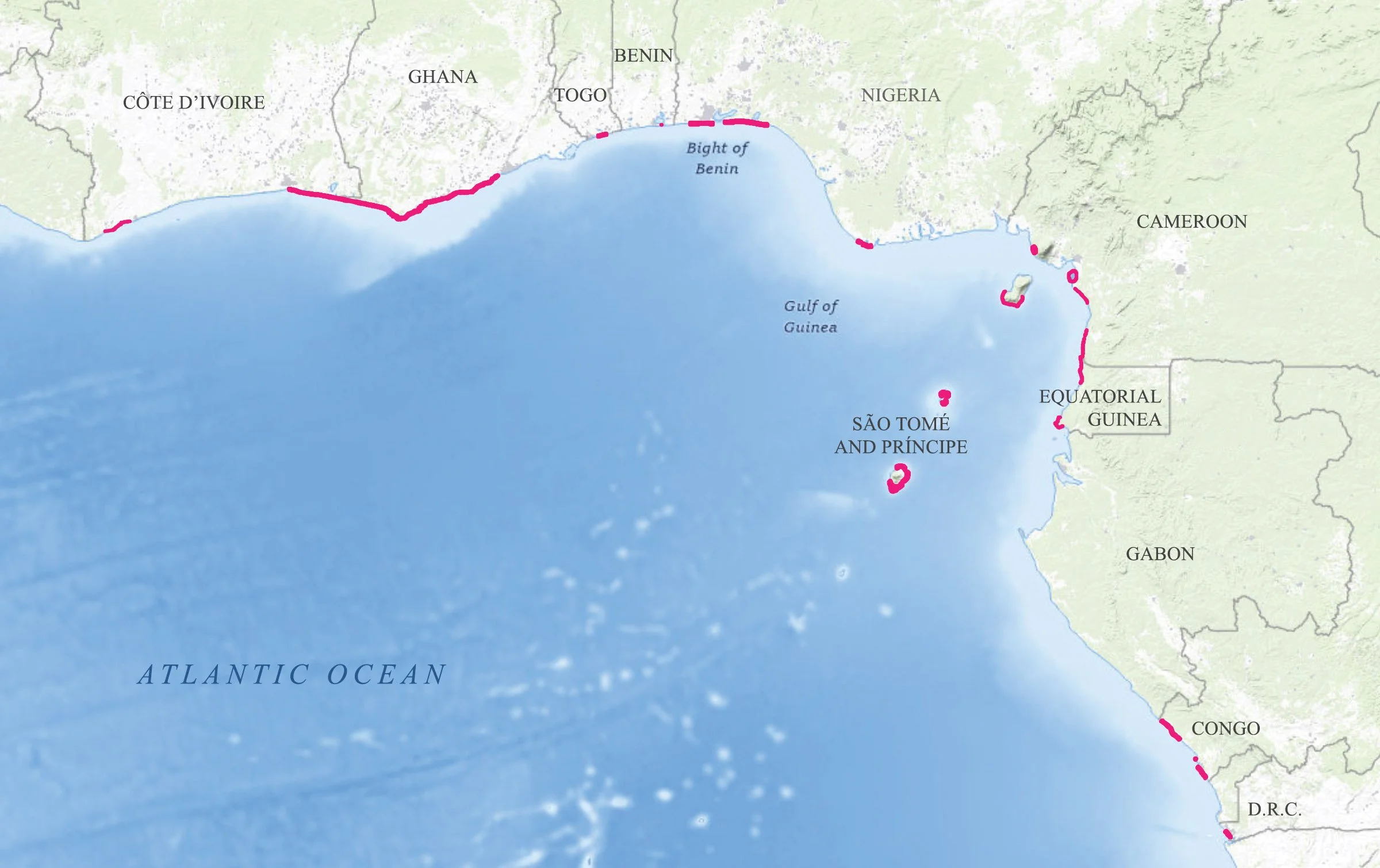
This map of Africa’s Atlantic coast shows proposed IMTAs (pink) that resulted from a multinational expert workshop in 2025. The proposed IMTAs were identified using a combination of scientific data and expert input.
More than 40 representatives from 14 countries were present at the four-day workshop, including marine biologists, spatial analysts, and community advocates. Workshop sessions discussed topics ranging from data collection, georeferencing techniques, mapping, and methods for integrating and managing metadata on ecological and cultural knowledge to support IMTA status. In addition, the project began developing a geospatial database by compiling site nominations and supporting materials from participating countries, such as maps, spatial files, field reports, and annotated images. Data have been compiled to delineate 22 IMTA proposals for Central Africa and 13 proposals for West Africa, with several more under development (see map on p. 14).
One example of a proposed IMTA is Youmet II Kombo Mukala, a previously undocumented sea turtle nesting and foraging site in Cameroon that a Cameroonian expert identified and submitted during the workshop. Similar discoveries across West and Central Africa highlight how grassroots data collection can expand the known range of sea turtle critical habitats.
More to Come …
This first African-led effort to identify IMTAs highlights the power of regional collaboration among strong networks across the continent. Initiated and coordinated by RASTOMA, the process brought together conservationists representing all levels of sea turtle expertise from a wide range of African countries in a setting that created powerful synergy and camaraderie around a shared vision. The IMTA workshop was a practical demonstration of how African leadership can drive meaningful contributions to global sea turtle conservation.
The workshop was just the beginning of a growing, continent-wide effort. As more sites are proposed and additional countries engage in the IMTA process, the results will provide incalculably valuable guidance for marine planning, conservation action, and policy decisions.
This article originally appeared in SWOT Report, vol. 21 (2026). Download the full report as a PDF.