
The Guianas at a Crossroads: Leatherbacks, Illegal Fishing, and the Cost of Inaction
By Audrey Chevalier
As the Amazon River flows into the Atlantic Ocean, it carries vast amounts of organic matter that are pushed northward along the coast of South America by the North Brazilian Current. This system floods the coastal waters of the Guianas (French Guiana, Suriname, and Guyana) with nutrient-rich waters, creating one of the world’s most productive marine ecosystems in terms of chlorophyll, biomass, and marine species diversity. These “chocolate waters,” as they are called locally, support abundant fish populations and significant coastal fisheries that provide employment and affordable, high-quality animal protein to local communities.
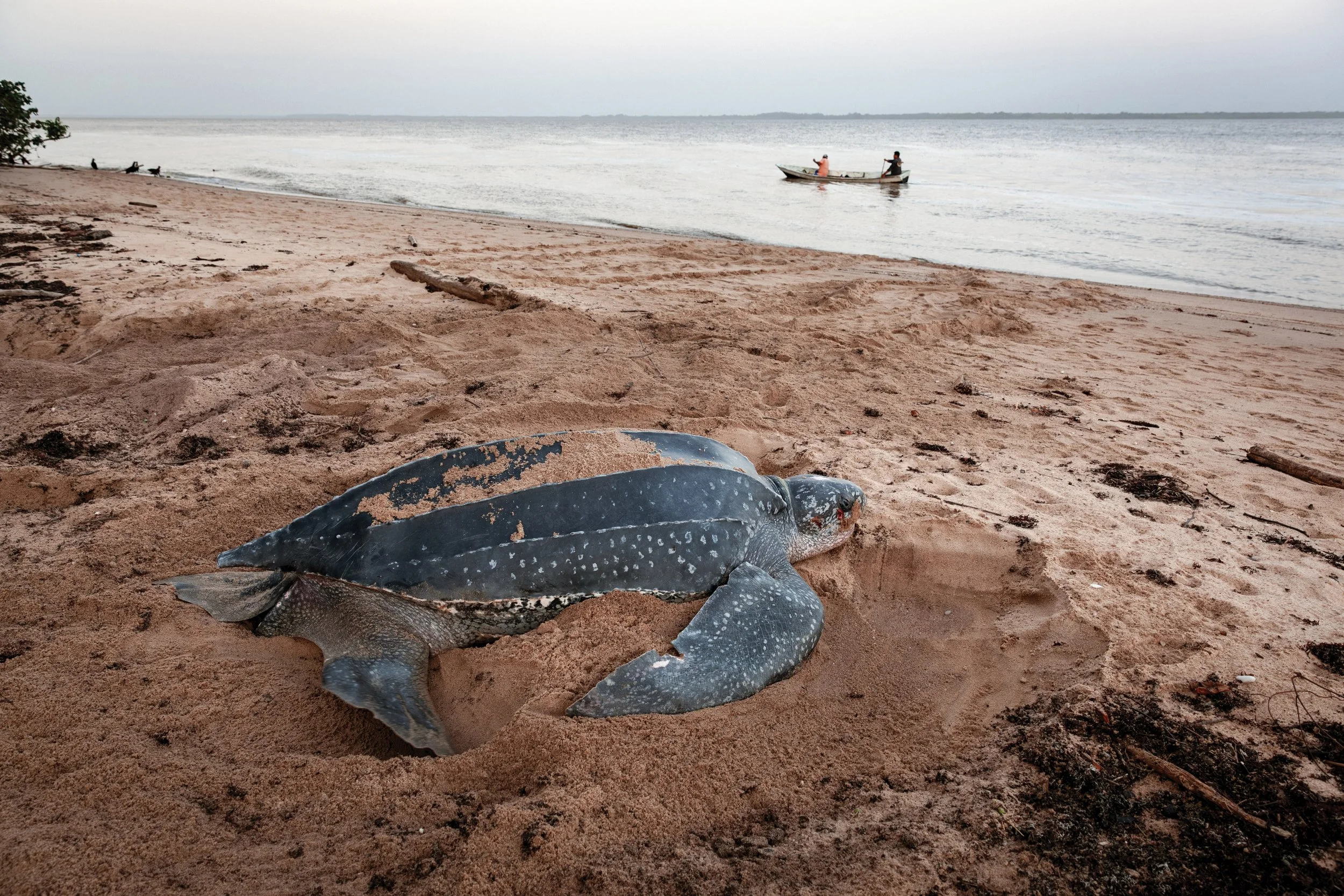
A leatherback nests in Awala-Yalimapo, French Guiana, where the population, once considered the world’s largest, has declined by an estimated 99 percent since the early 2010s. Rampant illegal, unreported, and unregulated (IUU) fishing is thought to be one of the main drivers of the decline. © Julien Clozeau/Zeppeli
The Guianas also once hosted the world’s largest leatherback turtle population, which at its peak accounted for an estimated 40 percent of all global leatherback nesting on the legendary beaches of the Maroni Estuary, with Awala-Yalimapo (French Guiana) on the right bank and Galibi (Suriname) on the left. Today, the picture is starkly different. Numbers of nesting leatherbacks in the Maroni Estuary have been in continuous decline since the early 2010s and have fallen by an estimated 99 percent. The region’s once-abundant fish stocks are also showing signs of collapse, with many species severely overfished.
Since the early 2000s, local communities, fishers, and conservationists have reported significant numbers of illegal, unreported, and unregulated (IUU) fishing vessels deploying drift gillnets, a highly nonselective type of gear that entangles a wide range of marine species of all sizes. Gillnets used by IUU fishers often violate laws designed to limit environmental impacts, including maximum net lengths of 2.5 kilometers (1.5 miles) (according to European law) and minimum mesh sizes of 80 millimeters (3 inches) (stretched length). Investigations have revealed that illegal vessels routinely use nets averaging 5 kilometers (3 miles) long with a small mesh that captures both juvenile and adult fish. Moreover, these boats frequently work in coordinated fleets that align multiple vessels side by side, effectively blocking major swaths of the Guianas coastline.
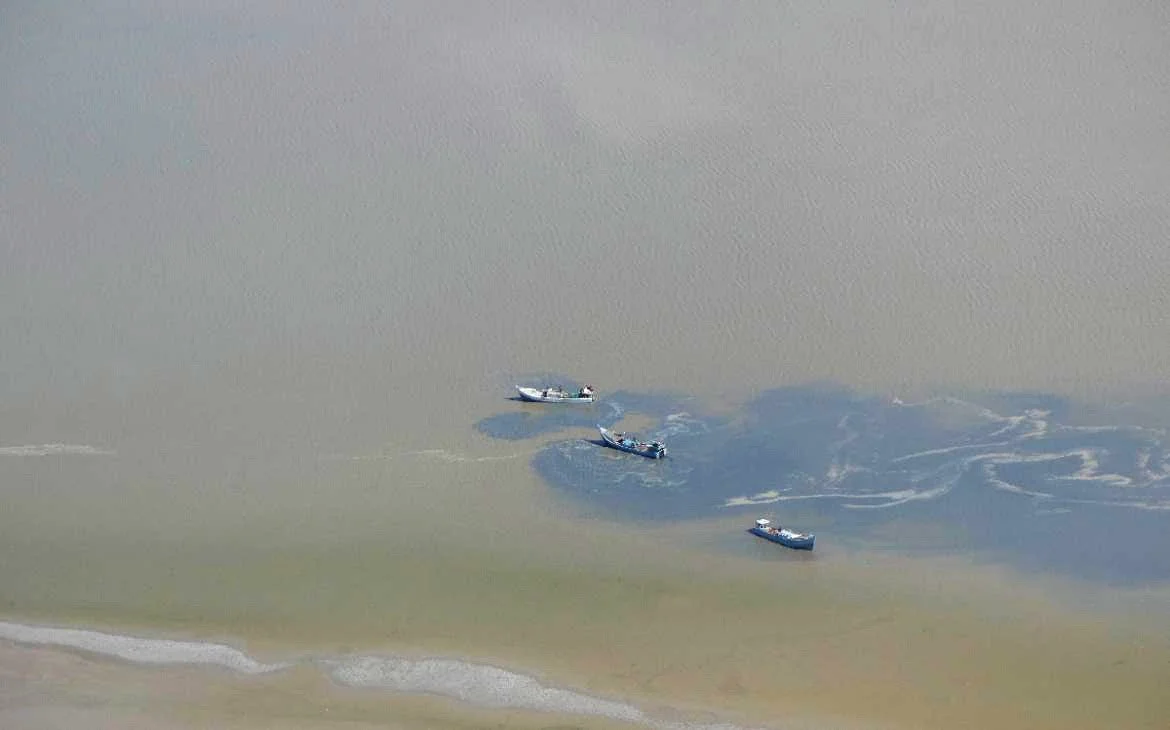
Three illegal fishing boats work in alignment to create a large barrier of mesh net along the Guianan coastline. The practice is detrimental to leatherbacks, which cannot see or avoid the nets in the murky waters. © WWF French Guiana
Not surprisingly, the ecological consequences of this extraction have been devastating, and leatherbacks are especially vulnerable to this gear. Unlike other sea turtles, leatherbacks cannot easily maneuver around obstacles; their large, heavy bodies and ancient reptilian brains do not allow them to respond quickly to avoid obstacles. A drifting gillnet, completely invisible to them in these highly turbid waters, becomes a lethal trap. Turtles become entangled in the mesh or float lines, struggle to escape, exhaust themselves, and eventually drown. In 2001, 11 adult leatherbacks were found dead in a single net segment off the coast of Awala-Yalimapo, an early warning of the now-observed collapse in the ecosystem.
By 2024, the scale of the IUU fishing problem had multiplied dramatically, with an average of 15 boats operating daily in the Awala area, collectively deploying some 60 kilometers (37 miles) of net spread directly across the turtles’ migratory route. As years passed without effective enforcement to stop these illegal practices, mass mortality followed, and the number of leatherbacks returning to nest plummeted. By 2025, only 17 leatherbacks nested in Awala, a dramatic decline from the estimated 1,000 per year in the 1990s.
Sea turtles are often described as “indicator species” because their decline signals a broader ecological problem. In the Guianas, those warnings went unheeded, to the detriment of the leatherbacks and many other marine species. For the first time in history, a 2023 annual census of fish larvae in coastal mangroves documented a total absence of acoupa weakfish larvae in French Guiana, the region’s most important commercial fish species. Once abundant, acoupa is now among several coastal fish stocks showing clear signs of collapse.
Sadly, what began as an environmental crisis has now become a widespread social and economic concern as well. As fisheries decline because of IUU fishing pressures, local coastal communities that have depended on fishing are left struggling to maintain their livelihoods and secure affordable animal protein.
The collapse of Guianan leatherbacks, the ever-weakening fish stocks, and the subsequent demise of local community livelihoods must become a clarion call for coordinated regional action, including enforcement of regulations, realistic and efficient deterrence strategies to fight IUU fishing in national waters, improved environmental monitoring, and assistance to small-scale sustainable fisheries that support both local needs and a thriving economy in the region. If these steps are taken now, there may still be time to protect what remains of the region’s chocolate waters and their rich marine diversity.
This article originally appeared in SWOT Report, vol. 21 (2026). Download the full report as a PDF.