
FAQs About Sea Turtles: Do Sea Turtles Communicate?
By Kostas Papafitsoros and Damien Chevallier
Sea turtles were once thought to be largely solitary and silent, but emerging research and observations challenge this long-held belief. Scientists now know that turtles use a combination of physical interactions, chemical cues, and sounds to navigate surprisingly complex social environments.
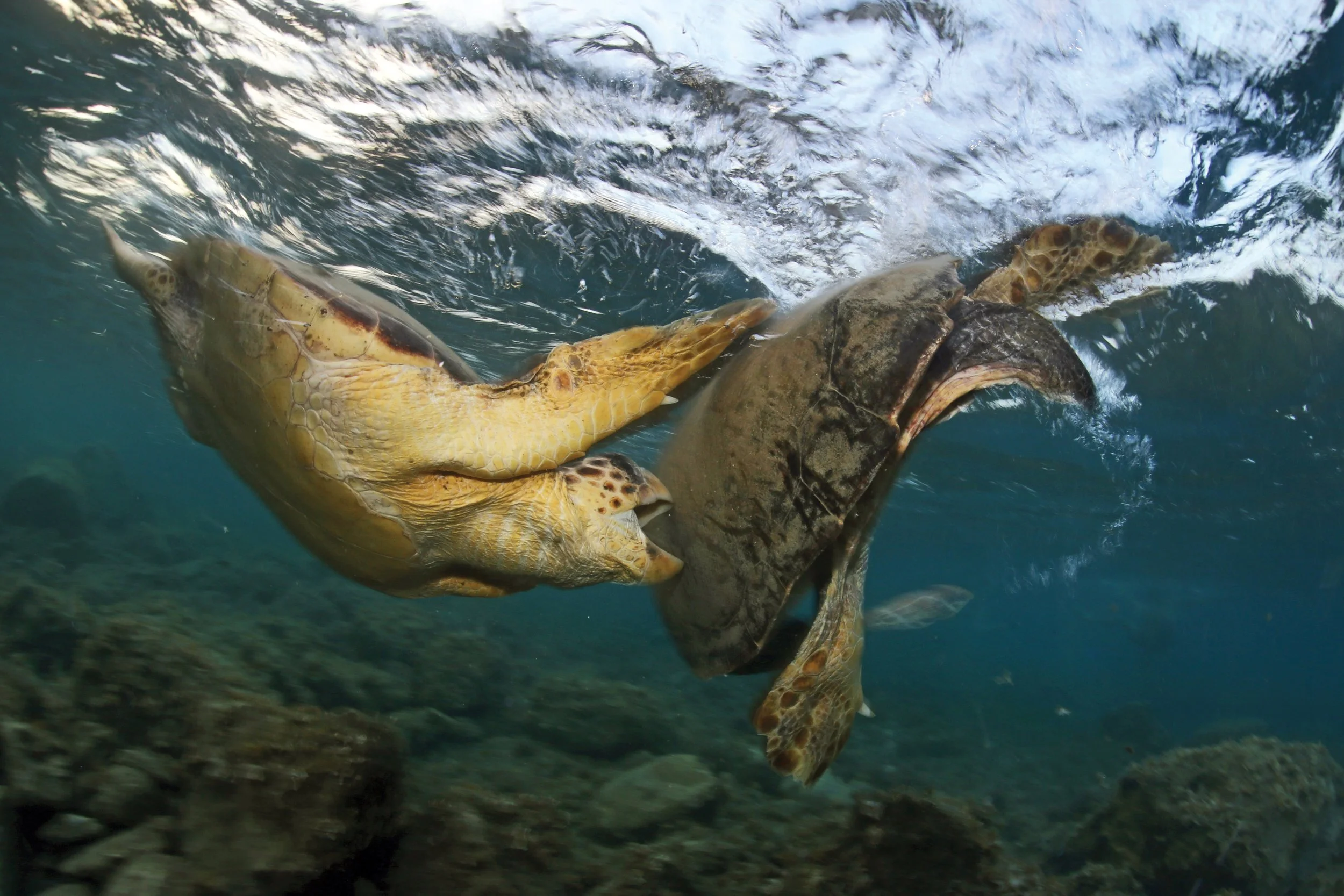
A juvenile loggerhead passes the message, “Get out of here!” to a male loggerhead that is invading its foraging spot near Zakynthos Island, Greece. © Kostas Papafitsoros
Nonvocal Communication
Much of sea turtle communication appears to be physical. During the mating season, for example, a female can express a decisive “no!” to an interested male by lifting herself vertically in the water with her plastron facing him, making a mating attempt impossible. In foraging grounds where many turtles share space and resources, sea turtles also engage in frequent social interactions. A long-term study at a small foraging patch on Zakynthos Island, Greece, found that certain individual loggerheads aggressively chase and bite turtles that intrude on their preferred feeding areas—behavior that clearly communicates territorial defense.
Not all interactions carry such obvious intent. Across species, including loggerheads, greens, and hawksbills, divers and researchers have documented nonaggressive pursuits, rubbing, and beak touching. The purpose of these subtler behaviors remains open to interpretation. Yet because sea turtles can detect waterborne odors, close-contact behaviors such as beak touching could work in tandem with olfaction to exchange information. Whether this represents deliberate communication is still unknown, but it highlights an intriguing dimension of turtle social behavior that is worthy of future study.
Vocal Communication
Although sea turtles were long considered silent, recent acoustic research shows that they can both hear and produce a range of underwater sounds. Using multisensor acoustic and video recorders attached to free-ranging, juvenile green turtles, scientists have documented the turtles emitting pulses, rumbles, squeaks, and grunts within their hearing range (50–1,600 Hz).
Some of the sounds appear to play a social role. Nighttime “rumbles,” for instance, often involve several individuals vocalizing together, hinting at group-level interactions. Other vocalizations, such as long squeaks or sharp grunts, occur frequently around other turtles and even humans and may function as alert or alarm signals. Playback experiments reinforce this idea: When exposed to recorded turtle sounds, other turtles often show vigilance or avoidance behaviors, demonstrating that acoustic communication continues well beyond early-life stages.
Studies also show that embryos and hatchlings of several sea turtle species—including green turtles, leatherbacks, olive ridleys, and Kemp’s ridleys—produce a variety of sounds from within the nest chamber. These vocalizations increase shortly before emergence and are thought to help synchronize movement up the nest column and coordinate the group exodus, a behavior that likely improves survival. This early-life signaling reveals that communication begins well before turtles reach the ocean.
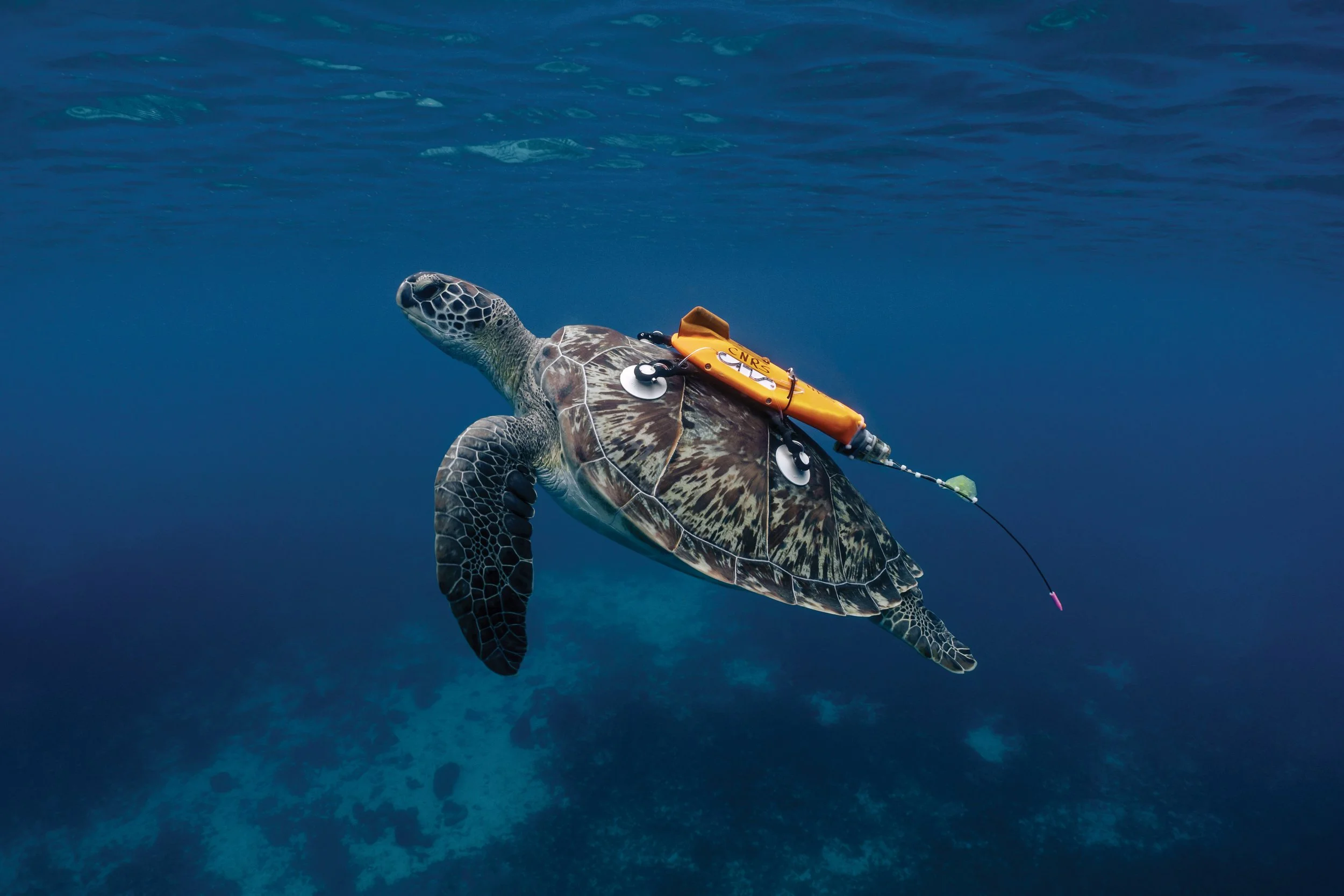
By attaching acoustic and video recorders to free-ranging juvenile green turtles, as seen here, scientists have discovered that sea turtles use a range of sounds to communicate with one another. © Damien Chevallier
Chemical Communication
Sea turtles possess well-developed nasal cavities suited for detecting scents, and some species have scent-emitting Rathke glands that can release chemical compounds into the water. Because turtles can detect waterborne odors, researchers have proposed that smell could contribute to social signaling. In one study, juvenile green turtles exposed to odor extracts from adult males’ Rathke glands showed a marked decrease in activity, indicating that turtles can detect and respond to chemical cues produced by conspecifics. However, the specific functions of these cues remain unclear.
Taken together, these discoveries challenge the long-held view of sea turtles as mute and asocial animals. Instead, they reveal a diverse communication toolkit—physical interactions, chemical cues, and underwater vocalizations—that not only enriches our understanding of sea turtle behavior but also opens new possibilities for conservation, including the use of natural turtle sounds to help reduce fishery bycatch and other spatially explicit threats.
This article originally appeared in SWOT Report, vol. 21 (2026). Download the full report as a PDF.