
Jeanne A. Mortimer
This post is part of our Living Legends series that spotlights key people in sea turtle conservation.
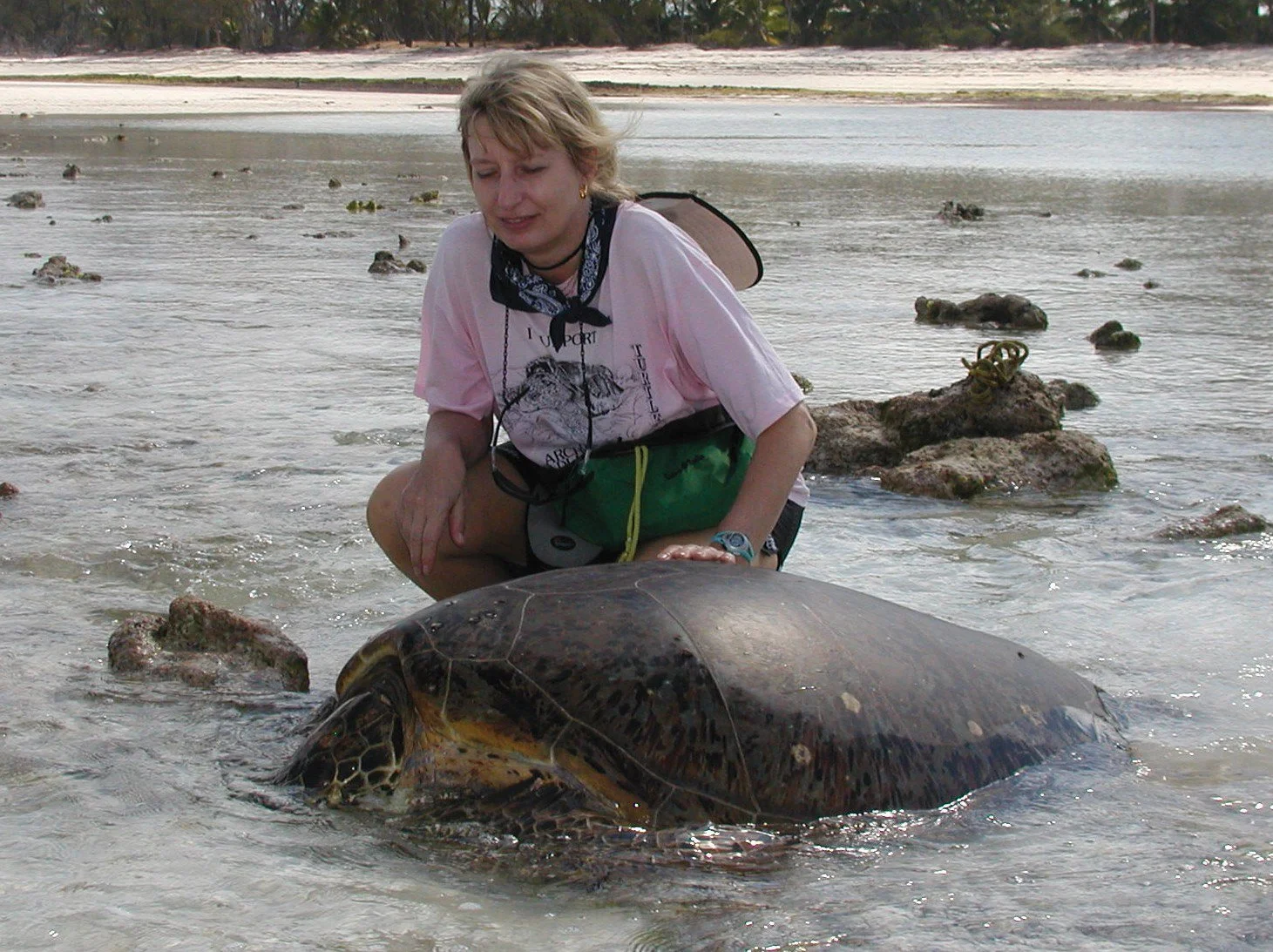
Jeanne Mortimer with a green turtle on Aldabra Island, Seychelles. © Rainer von Brandis
Born and raised in Chicago, Illinois, U.S.A., Jeanne spent every summer until age 20 at her family’s wilderness lodge in the Canadian North Woods, where she gained a passion for nature and an independent spirit. As an undergrad at the University of Notre Dame, she deepened her interests in tropical biology and human cultures. She earned her MSc and PhD degrees at the University of Florida, where, as a student of Dr. Archie Carr, she studied the diet of green turtles in Nicaragua and the nesting behavior of green turtles on Ascension Island. She next took a three-year consultancy with the World Wide Fund for Nature (WWF) and International Union for Conservation of Nature (IUCN) and with the Seychelles government to assess sea turtle status and to make management recommendations, a job that proved pivotal to her life. For more than five decades, she has worked on six continents, in some 20 countries, including Malaysia, Thailand, the Solomon Islands, Nicaragua, Costa Rica, and Brazil. But no matter where her work took her, she returned repeatedly to Seychelles for short visits. In 1995, she became a permanent resident; in 2007, she became a Seychellois citizen; and she continues to live and work there. Jeanne’s research interests include sea turtle nesting and foraging ecology, population status, growth rates, migrations, genetic phylogeny, human utilization, and conservation. Since 1995, her focus has been the Seychelles and Chagos Archipelago, and during the past decade she has worked extensively with seagrass ecosystems of the Western Indian Ocean. She retains her affiliation with the University of Florida, lectures at the University of Seychelles, and has authored or coauthored several books; dozens of peer-reviewed publications; and hundreds of non-peer-reviewed papers, book chapters, and reports.
Describe your first sea turtle moment
I spent the summer of 1973 exploring Costa Rica, an adventure that culminated with a month at the green turtle nesting beach at Tortuguero. I don’t recall my very first sea turtle, as there were so many! In those days, villagers were paid to turn the females onto their backs after they nested, then at dawn our team would walk the beach applying tags, measuring the females, and releasing them. Dr. Carr and his wife Marjorie lived at Tortuguero that summer, though I met them only a few times because I was housed with the field crew (which included their son, David). I later learned that I made history as the first female member of the Tortuguero tagging team.
Describe your proudest accomplishment in sea turtle conservation
I am proud that my initial three-year study and 1984 report on status and management of Seychelles turtles provided the baseline data and arguments that local Seychellois conservationists (Lindsay Chong Seng, John Collie, Maxime Ferrari, and Nirmal Shah, among others) used to convince high-level decisionmakers and legislators to pass the 1994 Wild Animals (Turtles) Protection Regulations, making it illegal to disturb, catch, injure, fish, kill, sell, purchase, receive, or possess any sea turtle or turtle egg. Another proud accomplishment was to have been part of the Malaysian team (comprising colleagues at WWF Malaysia, Malaysian turtle champion Dr. Chan Eng Heng, and others) that provided data and arguments that convinced the government in the early 1990s to cease heavy exploitation of green turtle and hawksbill eggs in Peninsular Malaysia before their populations declined to the critically low levels of the leatherback. Both species responded well, especially at Pulau Redang, where Dr. Chan promoted natural, in situ incubation of green turtle clutches (without hatcheries).
What is different now than when you started?
When I first started working with sea turtles, the greatest threat they faced was direct exploitation: the killing of turtles for their meat, shell, skin (leather), and eggs. Often, we could tackle this threat by creating awareness among local people about the vulnerability of turtle populations and by helping them find economic benefits from activities such as turtle tourism. Today, purposeful killing of turtles is less of a problem, though other threats are more pervasive, insidious, and difficult to tackle. These threats include habitat destruction caused by unregulated coastal development, global climate change, plastic pollution, and accidental turtle mortality caused by commercial fisheries.
What are you most hopeful (and most worried) about?
I am most hopeful about the younger generation’s environmental awareness and concern, and everyone’s concern regarding the health of the oceans and of Earth. I worry about the money-driven cynicism of some large corporations and modern governments and the results of that cynicism, such as habitat destruction, plastic and air pollution, climate change, and overfishing.
What is your advice to people new to this field?
I was attracted to sea turtle research because I didn’t need to specialize as a marine biologist or a terrestrial biologist, and I could indulge my interest in human beings while promoting conservation. I don’t think I can give advice that will be relevant to everyone working with sea turtles because there are so many trajectories a person might take in the field. Instead, I can recommend what has worked for me:
Become familiar with the literature so that you know what work needs to be done. Learn as much as you can about biodiversity and how ecosystems function. Don’t specialize too much in the beginning.
Figure out how to get along with your fellow humans, even when their opinions differ from your own. Try to see the world from their perspective and avoid being too judgmental. Understand that there will always be competing interests that will demand a certain degree of compromise. But don’t be too quick to compromise. (The Force is with you.)
Work hard to make the changes you want to see and believe in the value and importance of your work.
Learn languages relevant to the regions where you work. English, Spanish, French, and Portuguese provide a good baseline, but one should also learn local dialects. Even if you are not fluent, people will appreciate your efforts.
Never lose your sense of humor or your curiosity about the world around you.
Make sure to have fun doing what you do.