
Colin Limpus
This post is part of our Living Legends series that spotlights key people in sea turtle conservation.
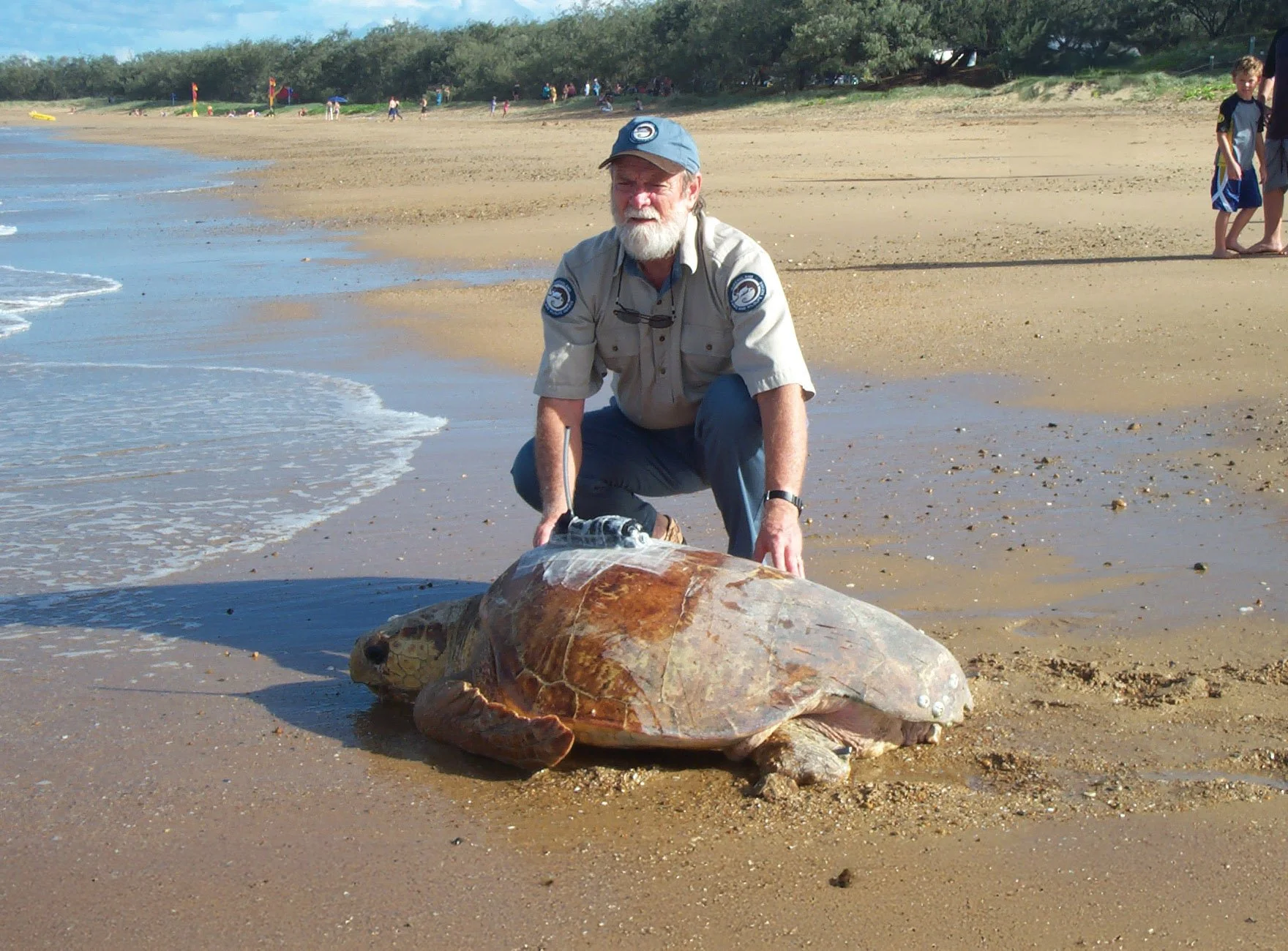
Colin Limpus poses with a loggerhead turtle fitted with a satellite transmitter.
Biography
Dr. Colin Limpus is one of Australia’s most distinguished sea turtle biologists, and he is among the world’s foremost authorities on marine turtle ecology and conservation. He is the former chief scientist and senior researcher for the Threatened Species Unit of the Queensland Department of Environment and Heritage Protection, a position he held for more than 50 years until his retirement in 2024. Commencing in 1995, he also served as the appointed scientific councilor for marine turtles for the United Nations Environment Programme Convention on Migratory Species.
Col began his sea turtle work in the late 1960s and went on to establish the Queensland Turtle Research Programme, one of the longest-running and most comprehensive sea turtle monitoring initiatives globally. Over his storied career, Col played a central role in shaping Australia’s understanding of sea turtle biology, demography, conservation, and management. He led pioneering research on nesting beach dynamics, reproductive ecology, hatchling production, migratory pathways, foraging habitats, and survivorship for all six marine turtle species occurring in Australian waters. His work at the Mon Repos turtle rookery helped transform it into an internationally recognized hub for loggerhead turtle conservation and public education, and his decades of monitoring at Raine Island provided essential data used to protect the world’s largest green turtle rookery. Col’s research contributions extend beyond sea turtles to other long-lived vertebrates, including freshwater turtles, crocodiles, dugongs, and sea snakes. He has authored or coauthored hundreds of scientific papers, technical reports, and assessments, and he has mentored multiple generations of researchers and conservation practitioners. Col’s efforts have directly contributed to national and international policy, threatened species listings, protected-area design, and recovery plans, leaving an enduring legacy for Australia’s marine wildlife and coastal ecosystems.
Describe your first sea turtle moment
I was five years old when I had my first encounter with a sea turtle. My dad took me to Mon Repos and showed me how to find nesting turtles and collect eggs to take home to eat. The memories are dim, much like the flashlights we had, but I recall that the turtle was big and I was not impressed with the eggs for eating. That outing was the first of what became annual visits each New Year’s Eve to watch nesting turtles at Mon Repos for a period spanning eight decades.
Describe your proudest accomplishment in sea turtle conservation
It was on December 26, 2003, when I first met Premiere (seen in the accompanying photo), a nesting loggerhead turtle at Mon Repos. She was the first confirmed return of about a quarter million loggerhead, green, and flatback hatchlings that my team had tagged using carapace notching during the 1970s and 1980s. Using laparoscopy, I was able to confirm that she had not produced eggs yet, and it appeared that she had migrated from a very distant foraging area. That assumption was tested by fitting her with a satellite tag. Her postnesting migration took her 1,400 kilometers (870 miles) north to the Howick Reefs in the Northern Great Barrier Reef. She has returned for five breeding seasons since 2003, and further tracking during two postnesting migrations shows that she has strong fidelity to both her home foraging area and her chosen nesting beach. Premiere and the many tagged hatchings that have returned to nest at Mon Repos for half a century have helped to increase our understanding of their complex life history.
What is different now than when you started?
The greatest changes (and understanding) have come with improved technology. When I commenced my formal turtle research in 1968, Western understanding of sea turtle biology was based largely on the folklore and traditional knowledge described by William Dampier in 1707. In those days, we did not know about temperature-dependent sex determination, geomagnetic imprinting of hatchling turtles to their natal shores, genetically independent stocks within species, the diverse endocrinology that drives the physiology of turtle breeding cycles, the reality of their long delay in aging to sexual maturity, or their potential for long breeding lives. Today, with computers, smartphones, and the internet, researchers have much greater access to the global literature on sea turtle biology and conservation, and they have access to a wide range of apps and statistical packages to assist in complex analyses that were not available to us half a century ago.
What are you most hopeful (and most worried) about?
I have confidence that the global community of local resident citizen scientists, Indigenous managers, university researchers, and government conservation agencies of countries where marine turtles occur will continue to monitor their populations and identify management issues. The challenges will include gathering the key data and crafting the persuasive justifications to keep governments focused and willing to curtail the impacts of the global industries that have created the ocean plastic pollution problem and that promote the continued mining and use of fossil fuels that have taken us into the global-warming era. Marine turtles with delayed maturity and potentially long reproductive lives can cope with short-term perturbations in their life history. The challenge for turtle conservation today is to provide arguments powerful enough to counter the views of those who oppose positive global and national response to reduce the effects of climate change.
What is your advice to people new to this field?
Don’t assume that something is true or proven just because it is published in a reputable journal or by an experienced researcher. You must check the facts: Were the methods and analyses appropriate for reaching the conclusions drawn? Separate the hypothesis from the experimental results. We still have much to learn about the functioning of sea turtle populations and how they respond to management regimes and to environmental change. Spend time with the turtles in the field and get to know their biology firsthand. I am presently collaborating with Dr. Andrea Whiting to rework the conclusions of a half-century-long analysis of flatback breeding for the Eastern Australian genetic stock, and we are retesting current hypotheses regarding population response to climate change.