
Joséa S. Dossou-Bodjrènou
This post is part of our Living Legends series that spotlights key people in sea turtle conservation.
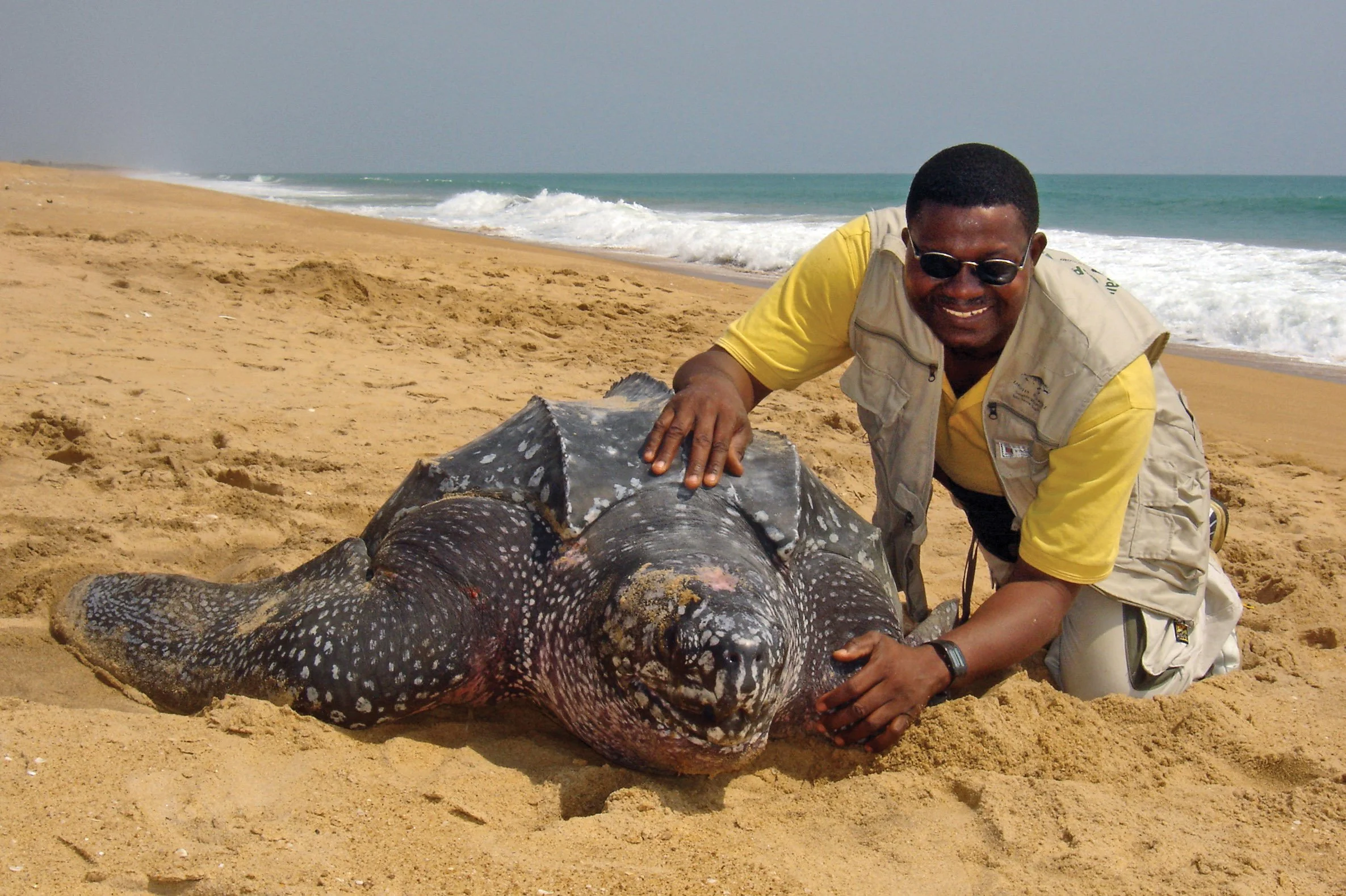
Joséa S. Dossou-Bodjrènou poses with a leatherback turtle on Benin’s coast.
Biography
One of Benin’s most respected naturalists and environmental leaders, Joséa is known for his lifelong commitment to wildlife conservation, environmental education, and community engagement. Though trained in animal production and health, he also has expertise (through practice and study) in museology, aquariology, taxidermy, plastodermy, and osteology, skills that have shaped his integrative approach to conservation. In 1995, he cofounded the nongovernmental organization Nature Tropicale, Benin’s first organization to join the IUCN in 2004 and one of West Africa’s most influential conservation institutions. Joséa has dedicated more than 30 years to advancing biodiversity protection across Benin’s wetlands, rivers, coastal ecosystems, and forests, spanning many important species and habitats, including sea turtles, manatees, marine and freshwater fish, amphibians, reptiles, and more (such as elephants in national parks). A champion of community-based conservation, he has built partnerships with local fishers, youth groups, schools, and government agencies to address poaching, habitat loss, unsustainable harvest, and human-wildlife conflict. As founder and director of the Musée des Sciences Naturelles (Museum of Natural Sciences) and its associated Center for Education and Sustainable Development in Benin, Joséa has helped transform environmental knowledge into accessible public programs that inspire national pride and stewardship. He has authored numerous publications, led public-awareness campaigns, and trained generations of conservation practitioners, teachers, and students. He is a long-standing member of the IUCN Marine Turtle Specialist Group, an active contributor to SWOT, and the recipient of a SWOT grant for his community-based sea turtle conservation efforts. Joséa is a respected leader in the conservation movement of Benin and throughout the West African region.
Describe your first sea turtle moment
I am from a small village in Benin’s Ouémé Valley called Hozin, which means “snail egg.” It is a neighborhood in the heart of the wetlands, and my family home is named Clovi (“baby turtle”) in reference to the freshwater turtles that can be found there. My family took me to the coastal town of Cotonou for vacation as a boy, and while there, I became fascinated by the olive ridley hatchlings on the beaches that were being collected by locals to keep at home as pets. From that time on, I became sensitive to the plight of turtles, which do not belong in households. Years later, the first conservation programs I led in the region focused on raising awareness among coastal residents about sea turtle protection, and this work ultimately led to the creation of my group Nature Tropicale in 1995.
Describe your proudest accomplishment in sea turtle conservation
My greatest pride, one that I share with my colleagues in sea turtle conservation, is having organized a large network of eco-volunteers, eco-guards, and other dedicated volunteers along the 125 kilometers (77 miles) of Benin’s coastline. These deeply committed people—many of them residents—work tirelessly day and night to save sea turtles and other marine and coastal wildlife, such as whales, dolphins, migratory birds, sharks, rays, and African manatees.
What is different now than when you started?
What is different today is the growing involvement of stakeholders at various levels. By involving everyone from poor coastal villagers to government officials, our work has contributed to the creation of some of the first marine protected areas in Benin, including the Donaten Marine Protected Area and the Bouche du Roy Marine Protected Area (established in 2022), which serve as migration, breeding, feeding, and conservation areas for many marine species. These areas are dedicated to tourism and recreational activities in marine and coastal environments in a country where wetlands are subject to enormous human pressures. This group of stakeholders has also actively contributed to the creation of biosphere reserves, including the transboundary Mono Delta Biosphere Reserve, which incorporates the Community Biodiversity Conservation Area of La Bouche du Roy, which was created in 2016 and covers coastal, lagoon, estuary, and mangrove ecosystems near the Bouche du Roy estuary. These protected zones preserve mangroves and important sea turtle areas, as well as critical habitats for endangered manatees. In addition, this group is active with the Lower Ouémé Valley Biosphere Reserve.
What are you most hopeful (and most worried) about?
My greatest hope is the engagement of an increasing number of stakeholders in sea turtle protection in Benin and across West Africa, including citizens, governments (local, regional, national, and multinational), and especially corporations. It is good news that companies working with coastal and marine resources are now taking an interest in sea turtles through their corporate social and environmental responsibility programs. My greatest worry is that some actors are entering the field of turtle conservation with no background or experience, seeking only an opportunity to make money at the expense of long-term conservation goals. There is a serious risk of “greenwashing” by unscrupulous participants.
What is your advice to people new to this field?
Commitment to saving sea turtles starts by obtaining basic training in the biology and conservation of the animals we aim to protect and learning about the national and international regulations that exist to support our work. We must also understand the human communities that interact and often depend on sea turtles for their survival, and then find ways to work directly with them to respectfully address their realities and how they can adapt to more nature-friendly ways. And it is important to always collaborate and to find power through collective actions, by integrating into existing networks and working in synergy with all the stakeholders at local, national, regional, and international levels.
Last and most important, slow down and stay focused. In a fast world, stillness becomes a radical and transformative act. True clarity and meaning in life come not from constant movement and distraction, but from pausing and spending time alone. Create and relish moments of thoughtful reflection by immersing yourself in the quiet outdoors. Nature can help us process our thoughts, appreciate what we have, and reconnect with what matters. Rather than chasing constant productivity or novel experiences, periods of stillness in nature can deepen your gratitude, reduce your restlessness, and open your eyes to what is essential.