
Head-Starting and Translocation: Lessons from Decades of Experiences
By Anna Barbanti, Anna Ortega, and Sean Williamson
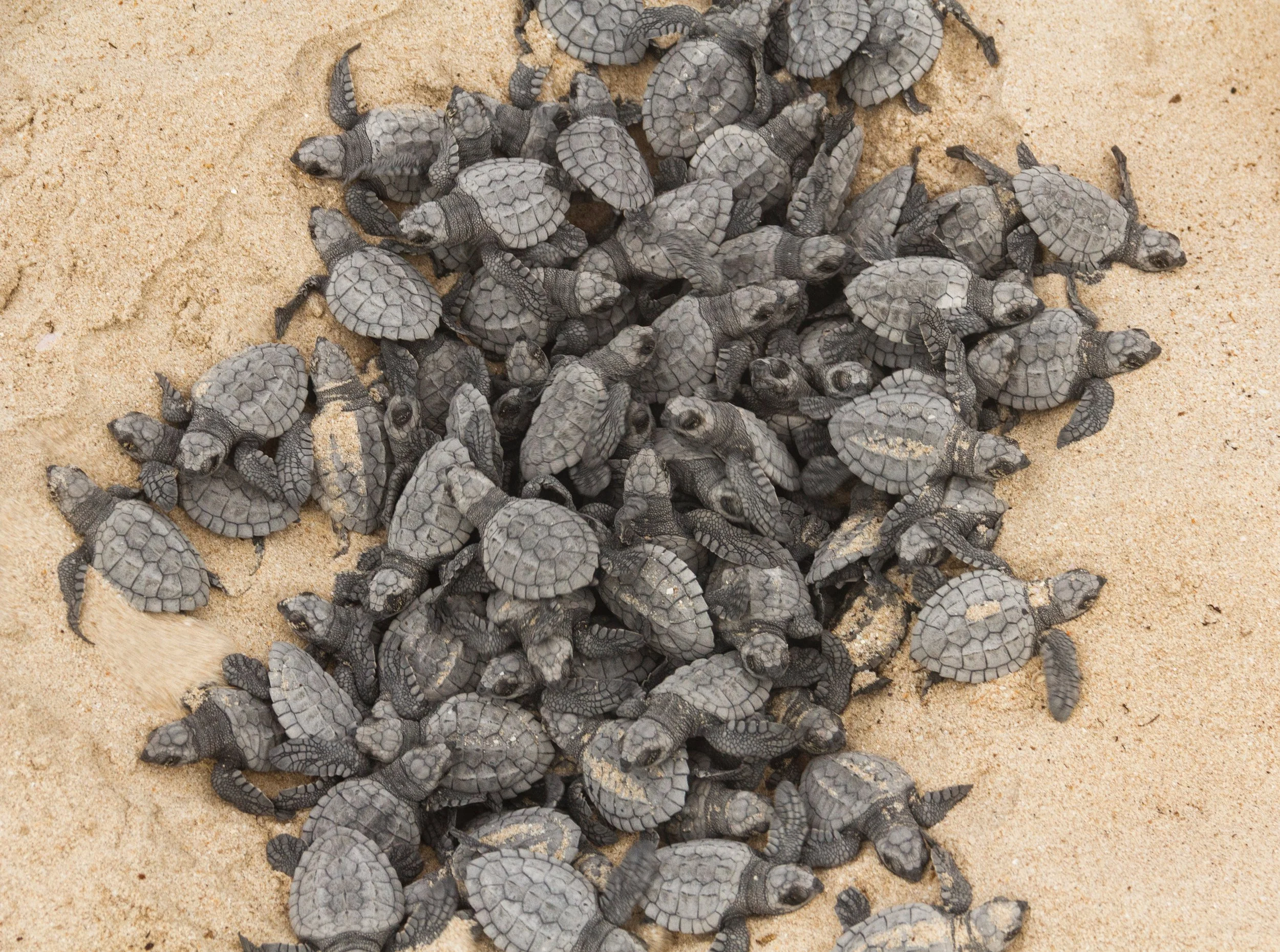
Kemp’s ridley hatchlings emerge from their nest inside a nesting corral in Rancho Nuevo, Tamaulipas, Mexico. © Héctor Chenge
Head-starting and translocation are wildlife management strategies that can be implemented to support the recovery of populations or species facing a steep decline. With sea turtles, head-starting involves rearing hatchlings in captivity before releasing them into the wild to increase survival through their most vulnerable early life stages. Translocation, by contrast, entails moving and releasing individuals (eggs or turtles) to safer locations within or outside the indigenous range of the species to achieve a conservation benefit, such as increasing a population size or avoiding erosion, predation, or habitat loss.
By the mid-20th century, sea turtle populations worldwide were declining rapidly because of intensive egg and adult turtle harvesting, coastal development, and incidental capture in fisheries. In some cases, managers believed that immediate interventions were needed to prevent collapse. At the time, little was known about the drivers of population recovery in sea turtles, and head-starting and translocations were viewed as practical, hands-on approaches that could quickly improve survival rates. Because natural mortality is highest during early life stages, conservationists hypothesized that boosting hatchling survival could enhance recruitment into breeding populations.
Programs in the 1960s and 1970s aimed to compensate for human-induced losses and to “head-start” populations toward recovery. Translocation efforts focused on relocating nests from threatened beaches to safer locations or restoring nesting where it had disappeared. Over time, however, concerns emerged about whether ex situ actions such as head-starting and translocation could inadvertently harm wild populations if poorly designed. Those concerns included questions about imprinting, survival skills, disease transmission, genetic integrity, and whether conservation resources might be better invested in protecting older life stages. Although decades of practice and research have addressed some uncertainties, many questions remain. In the following sections, we explore several examples of sea turtle head-starting and translocation and consider how these experiences inform present-day conservation decisions.
The Kemp’s Ridley Restoration and Enhancement Program
During the 1940s, the Kemp’s ridley sea turtle nested along the shores of Mexico in phenomenal arribadas. An amateur filmmaker documented one such event at Rancho Nuevo in 1947, where an estimated 40,000 females nested in a single day. By the 1960s and 1970s, however, the population hovered near collapse, with just a few hundred nests per year. In response to the imminent extinction of the species, the United States and Mexico launched an unprecedented binational recovery program that continues today.
To reestablish nesting on the Texas (U.S.A.) coast, where Kemp’s ridleys had historically nested but had become exceedingly rare, the program combined egg translocation, imprinting research, and head-starting. Between 1978 and 1988, eggs from Rancho Nuevo were transported to Padre Island National Seashore (Texas), where they were incubated and hatchlings were released into U.S. waters. A portion of each cohort was raised in captivity for 9 to 11 months, monitored for growth and health, tagged, and released into the Gulf of Mexico.
These ex situ interventions were paired deliberately with in situ threat reduction, most notably the introduction of turtle excluder devices in U.S. shrimp trawl fisheries. This integrated approach recognized that increasing early survival would be ineffective without reducing juvenile and adult mortality at sea. The first confirmed return to Texas of a head-started female in 1996 validated key assumptions about imprinting and survival. Nesting subsequently increased in both Mexico and Texas, peaking between 2009 and 2012, before declining again in later years. This variability underscored the vulnerability of the species to environmental variability and ongoing threats.
The Kemp’s ridley program remains one of the most ambitious and longest-running sea turtle recovery efforts worldwide. Its history offers critical lessons about the potentials and limits of head-starting, the importance of threat reduction across life stages, and the complexity of long-term population recovery.
The Cayman Islands Green Turtle Recovery
The Cayman Turtle Conservation and Education Centre began in 1968 as a commercial green turtle breeding facility and later evolved into a conservation, research, and tourism center. Early efforts involved acquiring adult breeding stock (more than 500 adults) from multiple Caribbean rookeries and translocating nearly half a million eggs to Grand Cayman Island to establish a head-start and reintroduction program.
In the 1980s, the focus shifted toward restoring the locally extinct Cayman Islands green turtle rookery. By 2001, more than 29,000 hatchlings and yearlings had been released. Long-term monitoring documented a recovery from a single nest in 1991 to 528 nests by 2022. To date, this program remains the only head-start program with scientifically demonstrated success in contributing to the recovery of a locally extinct sea turtle population.
The scale and longevity of the Cayman program enabled unprecedented research into captive rearing, growth, survival, behavior, genetics, tagging, and reintroduction. Long-term tagging and genetic fingerprinting allowed researchers to link captive-reared turtles to future nesting activity. The program also revealed important limitations. Maintaining a genetically diverse breeding population proved challenging, and the number of hatchlings released declined after 2002 because of logistical and biological constraints.
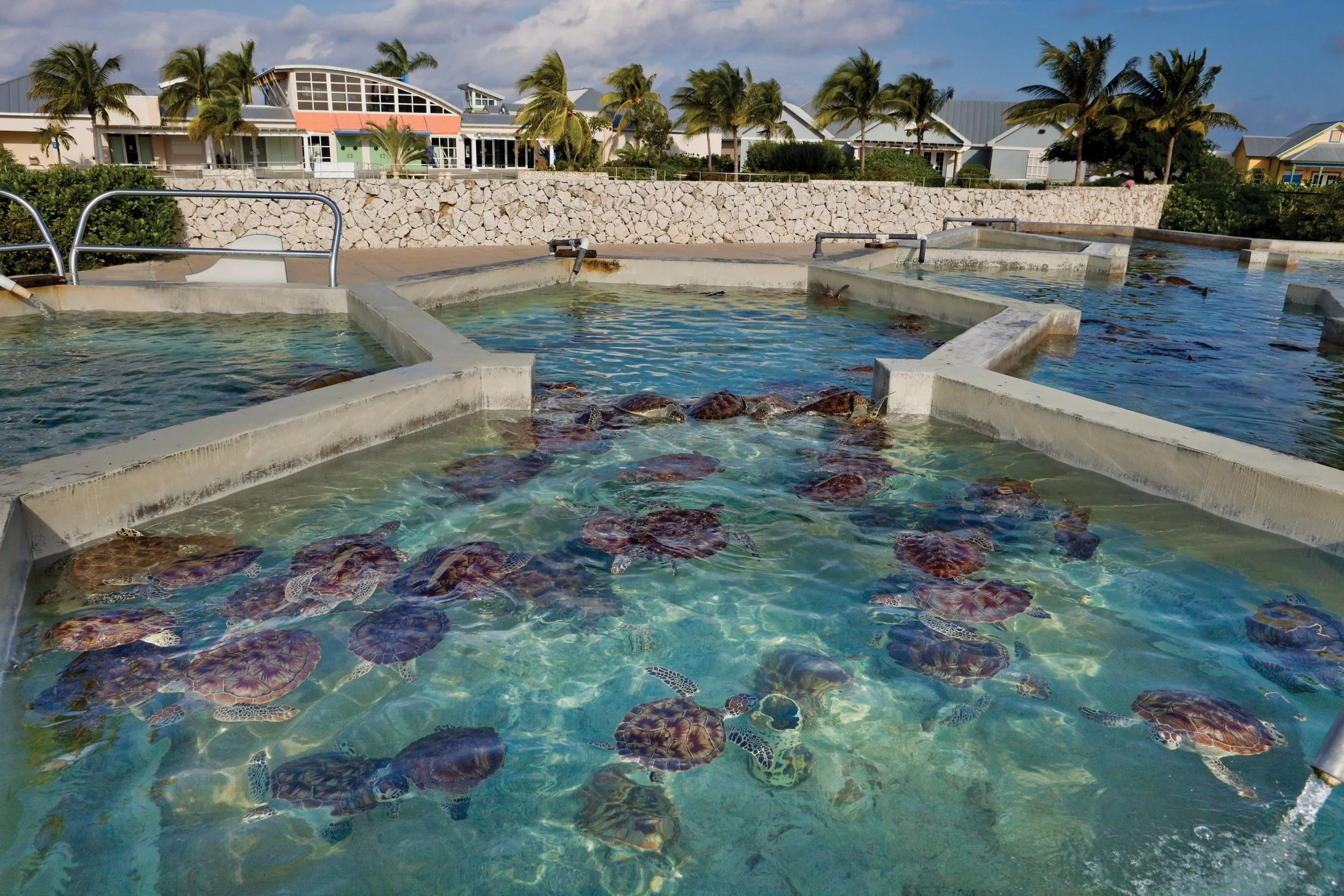
The Cayman Turtle Conservation and Education Centre in the Cayman Islands began in 1968 as a commercial green turtle farm and later morphed into a conservation, research, and tourism center. The center’s decades of work with captive breeding and reintroduction programs have yielded valuable insights that can inform other ex situ conservation efforts. © Flavio Vallenari
A 2019 genetic evaluation confirmed that at least 90 percent of nesting females and approximately 85 percent of hatchlings were the result of the reintroduction program. Remarkably, genetic analyses revealed the emergence of three distinct lineages within just two generations, highlighting how sea turtles can rapidly reshape population structure. This finding emphasizes the importance of incorporating genetic monitoring into any ex situ conservation effort. Despite decades of controversy, the Cayman program played a significant role in restoring a depleted rookery while advancing scientific understanding of captive breeding and ex situ management in long-lived marine species.
Other Head-Start Initiatives
Additional green turtle head-start efforts have occurred elsewhere with mixed outcomes. In Florida (U.S.A.), an experimental program was launched in 1971 before statewide nesting monitoring was established. Eggs collected from Atlantic coast beaches were artificially incubated, and hatchlings were reared in captivity for up to one year. Over 17 years, more than 18,000 head-started turtles were released. However, low recapture rates, concerns about male-biased sex ratios, and uncertainty about population-level benefits led to the program’s termination in 1988, after which head-starting was prohibited in the state. Nevertheless, since the program’s termination, six head-started turtles have been identified as adults, demonstrating survival to reproductive maturity after 15–26 years in the wild, an important finding.
In Australia’s Torres Strait, head-starting emerged from experimental turtle farming research in the 1970s. Eggs and nests expected to fail were incubated, and hatchlings were reared on multiple islands to engage local communities. Although the program yielded valuable insights into egg transport sensitivity, diet, and growth, extended captive rearing raised questions about delayed ocean entry and survival. No evidence of recruitment into breeding populations was documented, and the project concluded that turtle farming and associated head-starting were neither economically viable nor demonstrably effective as conservation tools under prevailing conditions.
Are Head-Starting and Translocation Relevant Today?
Questions about the feasibility and usefulness of head-start and translocation programs remain highly relevant, particularly for critically endangered populations such as the East Pacific leatherback turtle, which has declined by more than 95 percent since the 1980s. In 2021, a workshop convened a wide range of experts to evaluate whether ex situ interventions might complement in situ conservation.
After extensive discussion, participants acknowledged the risks and uncertainties of head-starting and translocation, and they agreed not to initiate full-scale ex situ programs, instead continuing to prioritize bycatch reduction while also pursuing research to fill remaining knowledge gaps about ex situ management.
A follow-up workshop in 2025 produced a 10-year research strategy (2026–2035) outlining a science-driven approach to evaluate the role of ex situ tools in East Pacific leatherback conservation. The strategy emphasizes hypothesis-driven research, adaptive governance, transparency, and coordination, and it establishes a framework in which any future interventions would be rigorously justified, transparently governed, and carefully monitored.
Where Does This Leave Us?
Decades ago, head-starting and translocation emerged from a sense of urgency to prevent extinction. That urgency has only intensified as climate change and other threats accelerate. Yet uncertainty surrounding these tools has often resulted in prolonged deliberation and inaction.
Debate persists, shaped by limited long-term data and polarized interpretations of success and risk, leaving many to wonder: Do these tools actually work? The honest answer is that we may never know with full certainty. Because ex situ interventions never occur in isolation and are often implemented alongside threat reduction, their true impact is difficult to quantify. What is clear is that any program employing these strategies must be grounded in rigorous planning, clearly defined objectives, and long-term monitoring. Only through long-term, well-designed planning and monitoring can conservationists track progress, understand population responses, and make informed decisions in the years to come.
This article originally appeared in SWOT Report, vol. 21 (2026). Download the full report as a PDF.