
The Conservation Status of Green Turtle Populations Worldwide
By Juan M. Rguez-Baron, Camryn D. Allen, Jérôme Bourjea, Annette C. Broderick, Milani Chaloupka, Mayeul Dalleau, Andreas Demetropoulos, Simon Demetropoulos, Irene K. Kelly, Noam Leader, Yaniv Levy, Angela Mastrogiacomo, Ana R. Patrício, Andrea D. Phillott, Nicolas J. Pilcher, ALan F. Rees, Jeffrey A. Seminoff, Erin E. Seney, Oğuz Türközan, Bryan P. Wallace, and the MTSG Green Turtle Red List working group
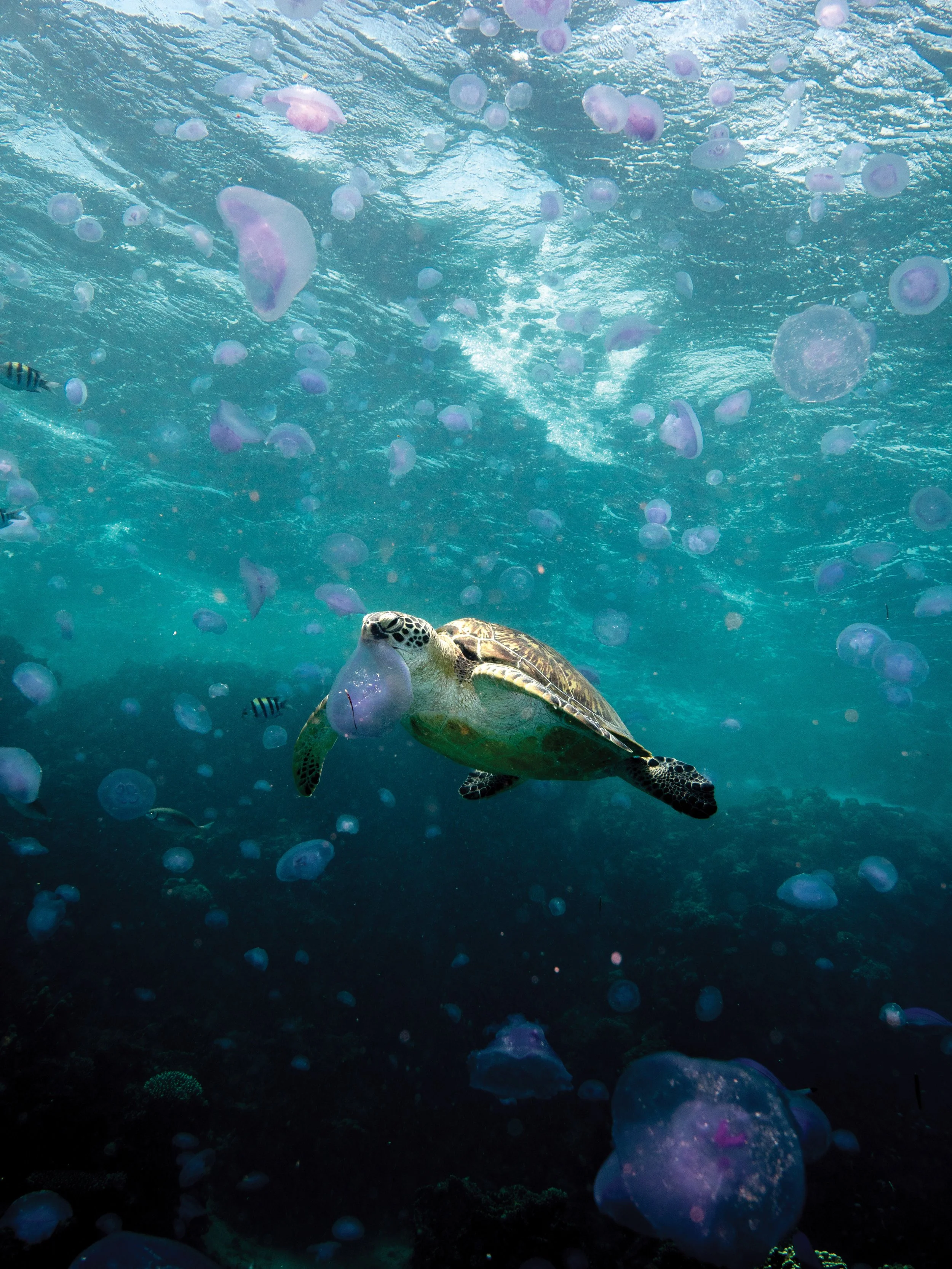
A green turtle feeds on a swarm of moon jellyfish in Egypt. © Abbi Hughes
Early logs from ships sailing the Caribbean and other tropical seas describe waters once teeming with green turtles. A Spanish chronicler traveling with Christopher Columbus during his second voyage (1493–1496) wrote while they were sailing along the coast of Cuba that “the sea was thick with turtles . . . so numerous that it seemed the ships would run aground on them.” When pioneering sea turtle biologist Archie Carr and colleagues began to document the status of sea turtles nearly five centuries later, they found a starkly different picture. Carr’s 1956 classic, The Windward Road, detailed the plight of the Caribbean green turtle, whose rookeries were a shadow of their former selves, and it served as the clarion call that effectively launched the modern sea turtle conservation movement. Seven decades later, the green turtle has come back from the brink and now stands as a riches-to-rags-to-riches tale of nature conservation. It is a poignant illustration of the arc from abundance to depletion at the hands of man, and ultimate recovery through decades of sustained management and conservation.
For centuries, green turtles faced the threat of intense direct take for meat, eggs, and other products. More recently, that threat has been combined with the widespread impacts from habitat loss, climate change, and incidental capture in fisheries. In 1982, the species was classified as Endangered on the International Union for Conservation of Nature (IUCN) Red List of Threatened Species. However, as conservation measures expanded globally, long-term monitoring has revealed a slow but steady recovery of the species. The most recent assessment by the IUCN-SSC (Species Survival Commission) Marine Turtle Specialist Group (MTSG), published in October 2025, reflects an encouraging turnaround: Globally, green turtles are now classified as Least Concern. This change is one of the most significant global status improvements ever documented for a long-lived marine vertebrate, and the shift is both scientifically significant and symbolically powerful.
For the first time, in addition to the global listing, the 2025 assessment also evaluated 11 green turtle subpopulations (regional management units, or RMUs), defined by long-term data on genetics, biogeography, tagging, movement behavior, demography, and expert knowledge. The RMU-based approach helped resolve a long-standing limitation of earlier global-only assessments, which could mask serious regional declines behind gains elsewhere. Over the past several years, dozens of MTSG experts contributed to a systematic process of collating, verifying, and reviewing decades of nesting and abundance data and of carefully applying Red List criteria to both the global population and each RMU. Notwithstanding these advances, applying Red List criteria to long-lived, migratory species such as sea turtles remains challenging, especially where data gaps or complex life histories make trends difficult to quantify.
The combined global and RMU-level assessments reveal a nuanced picture: Some green turtle subpopulations have undergone remarkable recoveries, while others remain small, fragmented, or in clear decline. These differences highlight not only the effectiveness of sustained conservation efforts but also the green turtle’s continued vulnerability to human impacts and its dependence on conservation.
Although the global gains in green turtle populations are encouraging, they also represent only a partial recovery. Green turtle numbers remain far below their pre-exploitation abundance, and 4 of the 11 RMUs are still in decline. Where protections hold, turtles rebound; where they weaken, declines persist. Whether this global improvement becomes a durable conservation success will depend on the world’s continued commitment to safeguarding the RMUs that remain most at risk.
Global (2025)
Least Concern
The green turtle is listed as Least Concern at the global level, meaning that the current risk of species extinction is low. Long-term conservation efforts across much of the green turtle’s range have led to a 28 percent increase overall in nesting across all rookeries included in the assessment. Nevertheless, status and conservation needs remain uneven across the green turtle’s 11 subpopulations, with several that are still small, fragmented, or exposed to substantial threats. Continued conservation efforts are needed across the green turtle’s range to maintain its Least Concern status, with special attention to addressing lagging regions and mitigating persistent threats from bycatch, take, and coastal development.
North Atlantic (2025)
Least Concern
Distributed from the southeastern United States and Caribbean to Macaronesia and West Africa, this subpopulation includes major rookeries in the United States (Florida), Mexico (Quintana Roo, Yucatán), Costa Rica (Tortuguero), and Aves Island (Venezuela). Long-term protection has produced substantial increases at several sites, yielding a 134 percent increase in total annual nesting from 1984 to 2023. However, recent downturns at key beaches, including Tortuguero, the largest rookery in the RMU, are concerning and warrant special focus. Priorities include managing bycatch, safeguarding nesting habitat amid development, and maintaining long-term monitoring to detect emerging trends.
South Atlantic (2019)
Least Concern
This subpopulation nests across many of the region’s 28 countries and dependencies, though only 8 were included in the assessment: Ascension Island (United Kingdom), Brazil, Equatorial Guinea, French Guiana, Guinea-Bissau, Príncipe Island (São Tomé and Príncipe), Suriname, and Venezuela. These areas have shown some of the most robust recoveries among all green turtle populations, with a collective 188 percent increase in nesting abundance from historical levels to 2017. Nesting trends have been strongly positive at several key beaches—notably Ascension Island. Nevertheless, bycatch and illegal take are persistent concerns, particularly in the eastern part of the region. Sustained protection of nesting beaches, coupled with expanded fishery mitigation, will be crucial to maintain these encouraging gains.
East Pacific (2023)
Vulnerable
East Pacific green turtles nest along the Pacific coasts of the Americas, from Mexico to Peru, and on offshore islands in the Galápagos (Ecuador) and the Tres Marías and Revillagigedo archipelagos (Mexico). Long-term data on nesting abundance are available from just two locations—Colola Beach in Michoacán (Mexico) and the Galápagos Islands—which together host 71 percent of all nesting in the region. Despite significant increases at both sites since the early 1980s, overall nesting abundance is about 45 percent lower than the earliest available data (1970s). The current classification reflects both partial recovery and continued threats from bycatch, illegal take (i.e., harvest), and habitat degradation.
Southwest Pacific (2025)
Vulnerable
Found across Australia, Papua New Guinea, Vanuatu, and nearby waters, this subpopulation includes the world’s largest green turtle rookery at Raine Island, Australia. It is assessed as Vulnerable because of a combination of its small and fragmented nesting areas, geographic isolation, and declines in some populations and critical habitats. Climate-driven impacts to nesting habitat, including storm erosion, saltwater intrusion, and sand temperature rise, are of particular concern and have already led to a decline in hatchling production at Raine Island.
Central West Pacific (2023)
Near Threatened
The Central West Pacific subpopulation includes nesting populations dispersed across a vast geographic range that consists of small, isolated beaches in Japan’s Ogasawara Islands, Palau, Guam, the Commonwealth of the Northern Mariana Islands, the Federated States of Micronesia, West Papua (Indonesia), Papua New Guinea, the Marshall Islands, and the Solomon Islands. Of the six long-term nesting datasets that are available, the nesting populations on Hahajima and Chichijima (part of the Ogasawara Island group) show the most robust growth, contributing to a 60 percent increase overall in nesting abundance across available index sites until 2021. Despite the recent gains in Japan, the status of this subpopulation is influenced by its small area of nesting habitat, which is distantly dispersed; by gaps in nesting site protection and monitoring; and by persistent threats from bycatch and direct take.
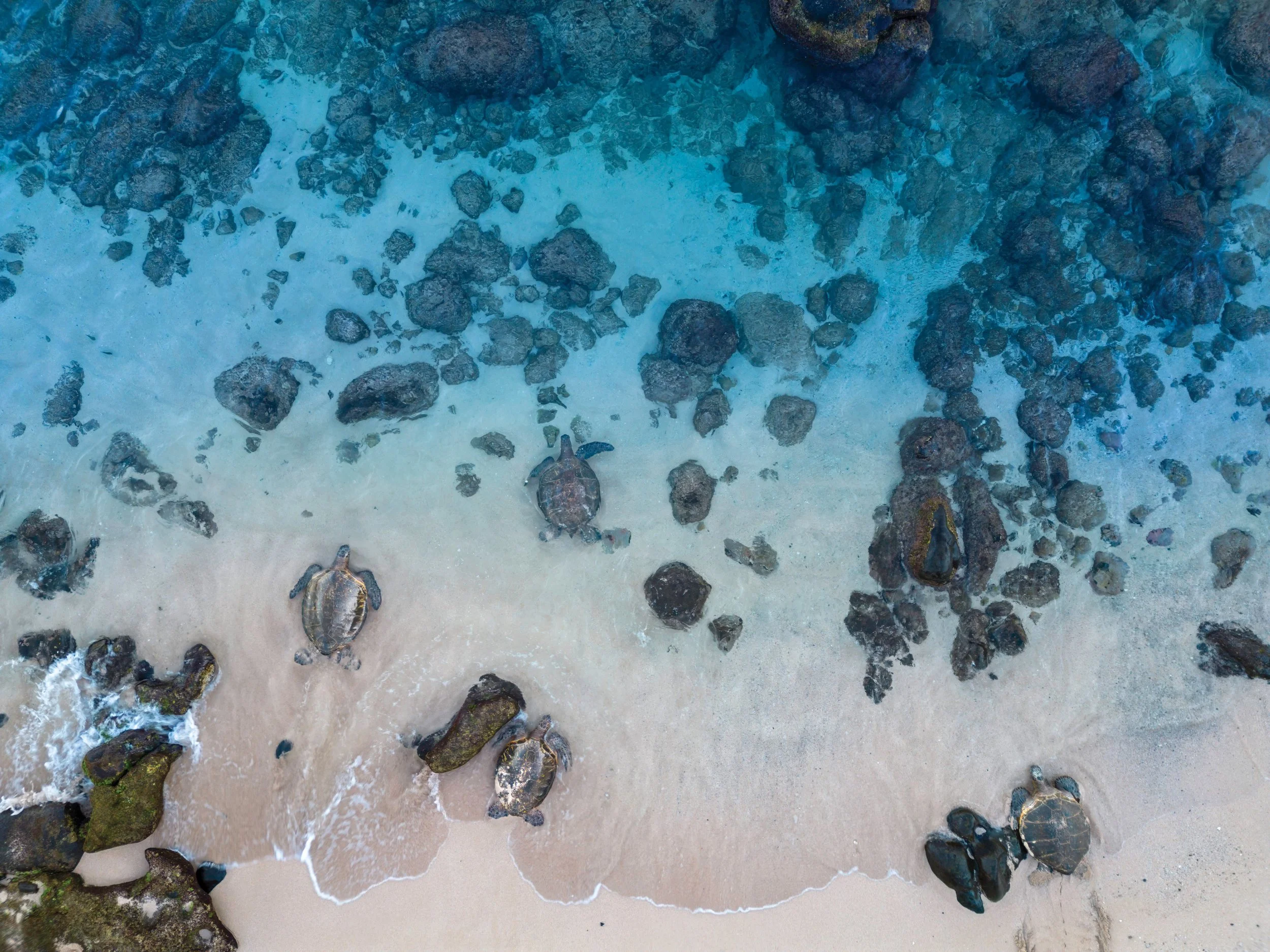
An aerial view shows several green turtles entering the ocean on Hookipa Beach, Maui, Hawaiʻi, U.S.A. © David Fleetham
Central South Pacific (2023)
Endangered
This small, fragmented subpopulation nests primarily in French Polynesia (Scilly Atoll), the Cook Islands, Kiribati, Tokelau, American Samoa, and Fiji, with minor nesting in Samoa, Tonga, Tuvalu, and Pitcairn. Quantitative data remain limited, but significant population declines have been observed, and the data are persistently low. Fewer than 3,000 mature females, continued low abundance, and geographic isolation pose serious recovery and monitoring constraints. Ongoing bycatch in longline fisheries and direct take of adult turtles remain major threats.
Central North Pacific (2019)
Least Concern
This geographically isolated subpopulation nests exclusively in the Hawaiian archipelago. Most nesting occurs in Lalo (French Frigate Shoals), with a small amount of nesting activity scattered among the inhabited Hawaiian Islands. Once severely depleted, the population grew—following the enactment of protections beginning in the 1970s—at a rate of 5.44 percent annually until 2012. Its improved status was bolstered by the end of commercial harvest, rigorous protection of nesting beaches, and the absence of international pressures owing to its complete confinement within the Hawaiian archipelago. However, dependence on the two primary small nesting islets (East Island and Tern Island) in Lalo leaves this subpopulation highly vulnerable to climate-driven impacts to nesting habitats, such as erosion, inundation, and warming sand and incubation temperatures. Moreover, recent assessments show a potential shift from growth to decline, suggesting that its Least Concern status warrants careful reevaluation.
North Indian (2019)
Vulnerable
Nesting primarily in Oman and the Republic of Yemen, with marine habitats spanning the Red Sea, Persian Gulf (also known as the Arabian Gulf), and Arabian Sea, this subpopulation has experienced notable declines at key nesting sites. Estimates of nesting in Oman and the Republic of Yemen indicate a 38 percent decline since the 1970s, although long-term data are limited and inconsistent. Significant threats from bycatch, turtle meat and egg harvesting, and habitat loss suggest the need for a precautionary approach to managing this subpopulation.
East Indian–West Pacific (2025)
Least Concern
Extending from Southeast Asia through the western Pacific and parts of the Indian Ocean, this subpopulation is broadly distributed, with dozens of nesting sites and 10 major rookeries in Indonesia, Malaysia, the Philippines, Vietnam, and western Australia, where thousands of turtles nest each year. Long-term data indicate a 1 percent overall decline through 2022, though local trends vary widely. The large population size and widespread distribution offset moderate localized losses. The region’s complex geophysical barriers limit genetic connectivity between rookeries, resulting in high genetic diversity (at least 26 distinct stocks). Loss in fisheries, both targeted and incidental, remains the biggest threat to the RMU, and ongoing protection of nesting sites, enforcement of take regulations, and habitat conservation remain high priorities.
Southwest Indian (2023)
Least Concern
This subpopulation nests widely along the East African coast, in Madagascar, and on many small islands throughout the region. Major nesting sites are found on isolated islands in the Mozambique Channel (e.g., Europa, Comoros, the Glorieuses, and Mayotte) and in southern Seychelles (Aldabra). Long-term monitoring data from major nesting sites show a 59 percent increase overall in nesting over about 30 years through 2020. The subpopulation has a large distribution and high genetic connectivity. However, persistent illegal take and incidental catch in artisanal fisheries continue to significantly affect turtles in parts of this region, and climate change–related risks pose a future threat to vulnerable island nesting sites.
Mediterranean (2024)
Near Threatened
The Mediterranean subpopulation nests mainly in Türkiye and Cyprus, with a smaller proportion nesting in the Syrian Arab Republic, Lebanon, Israel, and occasionally Egypt. This subpopulation forages throughout the eastern and central Mediterranean basins, particularly along the coasts of North Africa and the Levant. It has shown a 270 percent cumulative increase in nesting abundance over the past 30 years or so. However, the subpopulation also suffers from a limited nesting habitat (less than 300 kilometers, or 186 miles), genetic isolation, and ongoing threats from coastal development.
This article originally appeared in SWOT Report, vol. 21 (2026). Download the full report as a PDF.